Modern open-concept kitchens and ideas for integrating them into the living room
15/09/2026
Kitchens opening into the living room are still trending strong. And over the years, it's not only designers who've been falling for the comfort and versatility they offer, but the kitchen users too. But if you're planning this layout for your home, you might need a little help - along with some all-important inspiration.
That's why we're taking a look at the main advantages and disadvantages of open-plan kitchens, as well as some top tips for integrating your kitchen into your living area.
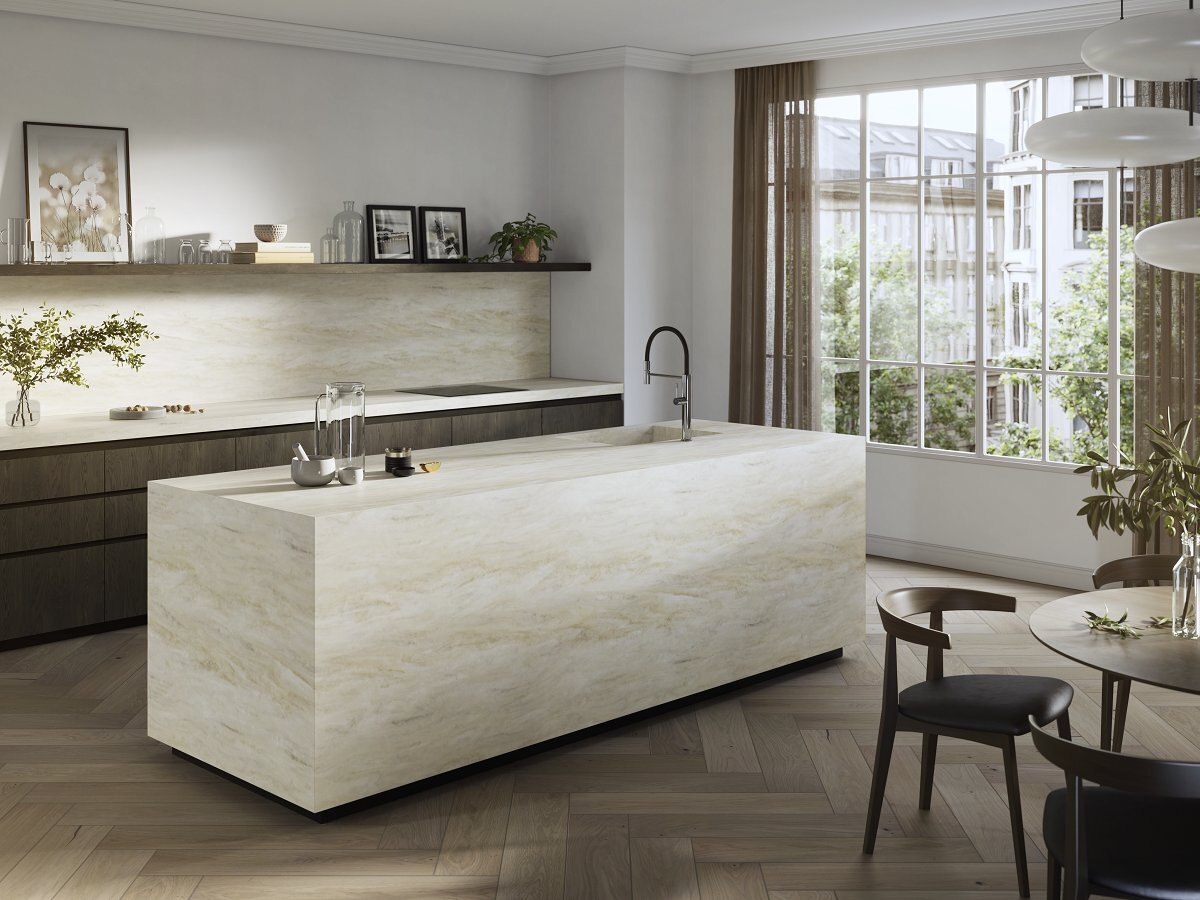
Krion® LUX Calacatta L11
First, what is a kitchen open to the living room?
A kitchen that is open to the living room is one that does not have partitions separating it from the rest of the rooms in the home.
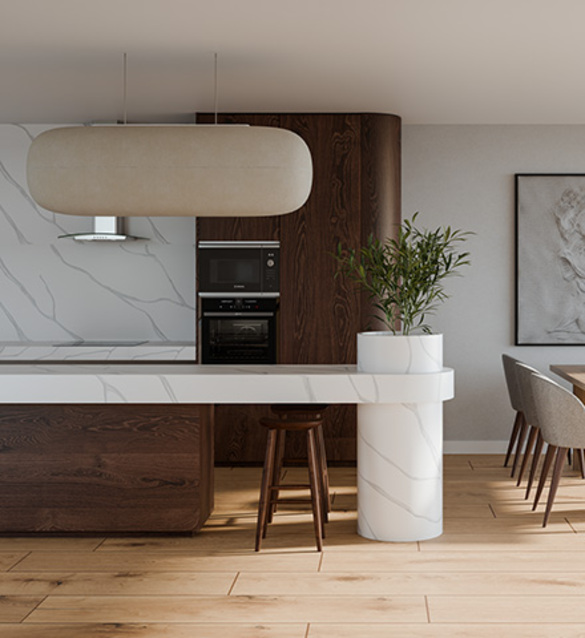
Krion® LUX L109 bianco cloud
But beyond eliminating the partitions that separate the areas, the open-plan kitchen requires a special layout. It needs to be highly functional. For this reason, it is necessary to think very carefully about the most effective way to locate the cooking and work areas, as well as the furniture.
Many kitchen worktops of this type have a dividing element that improves functionality without sacrificing openness. For example, a peninsula or island, a bar or even a removable glass partition. There are many ways to visually separate the kitchen from the rest of the space without incorporating dividing elements.
Ideas and types of kitchens open to the living room
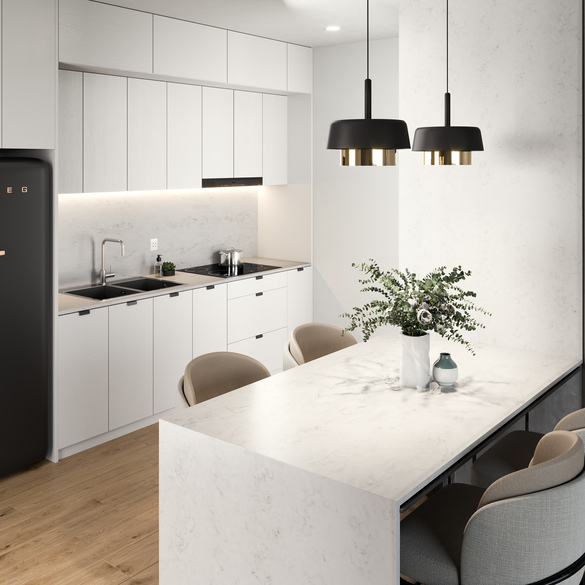
Krion® LUX snow white
Kitchens open to the living room have become one of the most sought-after options in contemporary interior design. The need to create more connected and functional spaces has led many people to opt for this layout, which offers both aesthetic and practical advantages.
If you are considering this style, it is essential to know the different configurations that allow you to make the most of the space.
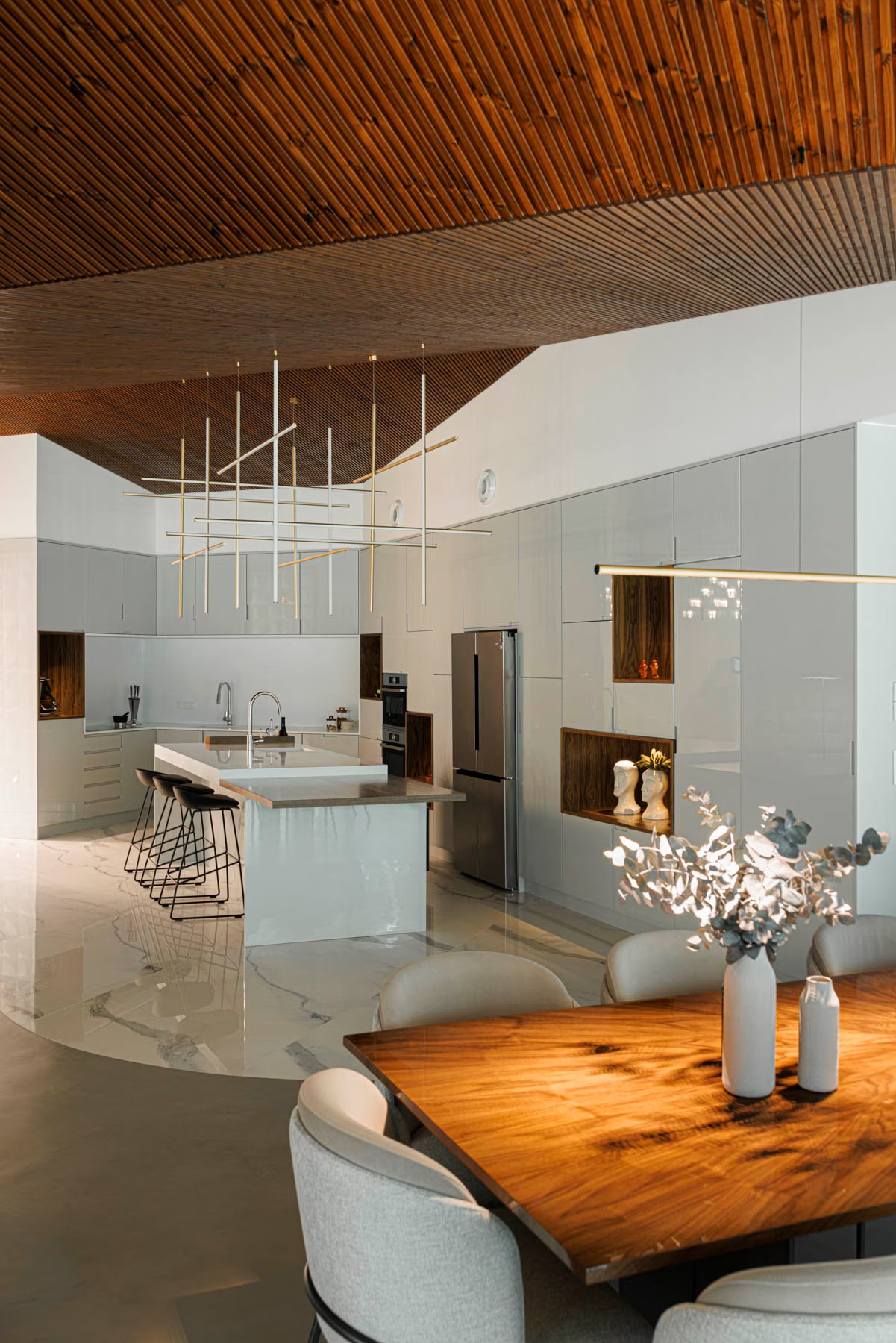
Open kitchens with island
One of the most popular solutions for kitchens that open onto the living room is the central island, an element that not only provides ample work space but also serves as a meeting area.
Architecture:INCEPTION
Photography: IVO TAVARES
View the project on Porcelanosa Projects
The island becomes the focal point of the kitchen, integrating seamlessly with the living and dining area and providing a fluid transition between spaces.
In addition, a well-designed island can include key elements such as sinks, induction hobs or additional storage, maximising the use of space.
Are you one of those people who love to enjoy the light coming through a window while you do the dishes? In a wall-mounted kitchen, the sink would make you turn your back on the light, but you can solve this by installing the sink on a peninsula facing the living room.
When combined with materials such as Krion®, the island stands out both for its functionality and its minimalist and elegant aesthetics. This material, with its excellent durability and easy maintenance, adapts perfectly to any decorative style, from the most modern to the most classic.
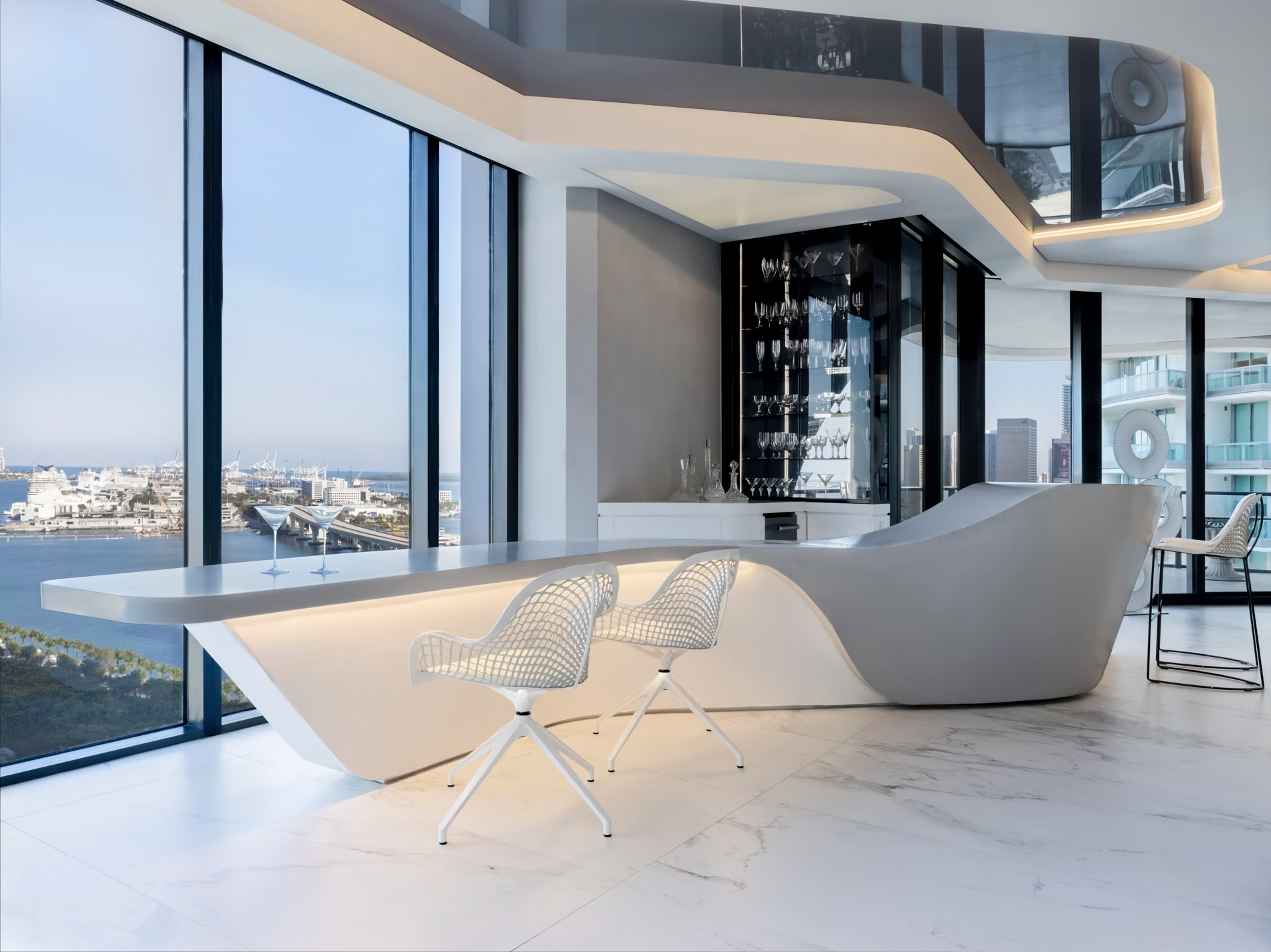
Open kitchens with bar
The bar is another option that continues to be one of the most popular in kitchens open to the living room. This type of kitchen is characterised by a subtle but effective separation between the two spaces, allowing for a seamless transition. The bar can function as a space for a quick bite to eat, enjoy a coffee or even as a small work area.
Interior design: NAR DESIGN STUDIO
View project on Porcelanosa Projects
The use of resistant and modern materials, such as Krion® surfaces, ensures that the bar is not only functional, but also an aesthetic highlight that complements the décor of the room.
This type of design is ideal for those who are looking for an informal and contemporary feel in their kitchen, without sacrificing practicality.
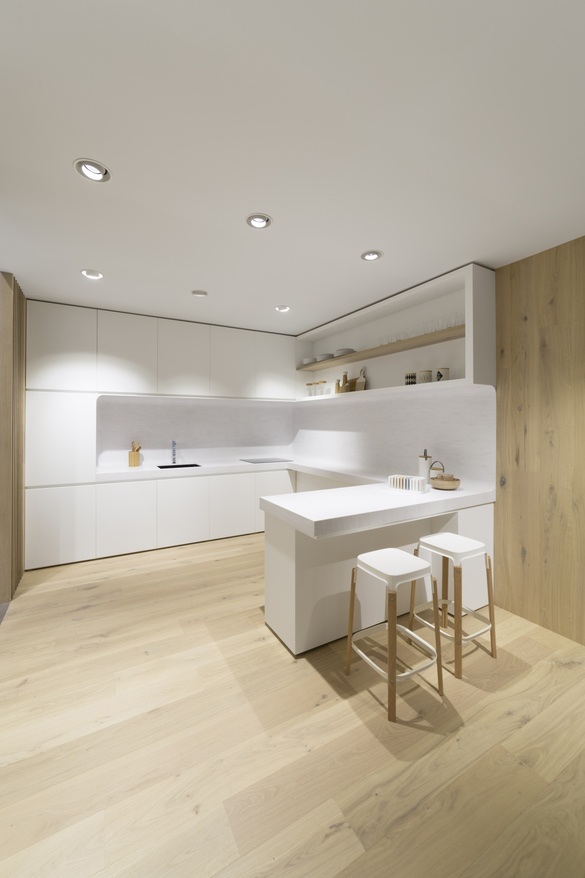
Open kitchens with peninsula
While the island is a classic in kitchens open to the living room, the peninsula has also gained popularity. Similar to the island, but with one side attached to the wall or a fixed structure, the peninsula allows you to create an open kitchen that maximises space without taking up too much of it.
It is a perfect alternative for medium-sized kitchens, as it facilitates circulation and offers an additional work surface.
By integrating a peninsula into an open kitchen, a more efficient layout can be achieved, especially when materials such as Krion® Lux are used for worktops and work surfaces.
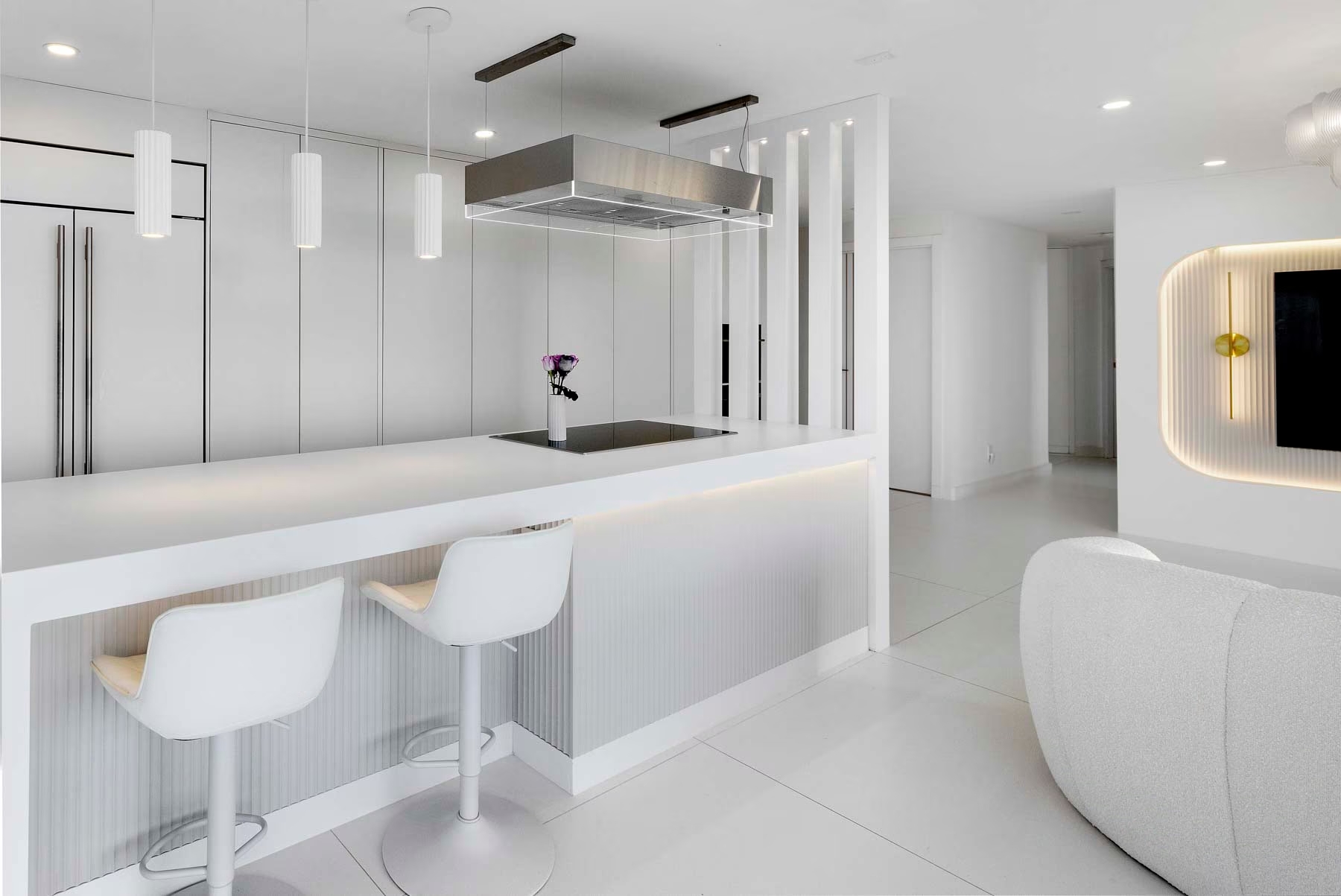
Semi-open kitchens with glass or partition panels
If you are not convinced by the idea of the kitchen being completely open to the living room, you can opt for an intermediate solution. The half-open kitchen with a dividing wall or a glass curtain or sliding door is a way of making the most of both options.
Interior design:M DESIGN STUDIO
Photography: MELANIE GREENE - GREENEHOUSE NYC
View the project on Porcelanosa Projects
Kitchens with glass doors are an option that not only provides luminosity, but also a feeling of spaciousness and openness. The use of these elements on the walls or in the kitchen partitions allows maintaining the sensation of visual continuity with the living room or dining room, without renouncing the independence of each space.
This option is perfect for those who are looking for a modern, bright kitchen that is visually integrated with the rest of the home.
For a touch of sophistication, they can be combined with materials such as Krion® Lux, which provides an elegant and resistant finish, ideal for work areas.
Advantages of a kitchen open to the living room
The benefits of kitchens open to the living room include the following:
1. Space multiplies
In a small home, a kitchen open to the living room allows you to visually enlarge the spaces. Instead of taking up metres with partition walls, you generate spaciousness with an open-plan space.

Photography: Eva Perez
View the project on: Conde Altea, (Valencia, Spain)
Architecture: Chiralt Arquitectos
Solutions from Porcelanosa Grupo, Noken, Xtone and Krion.
2. Better ventilation in the kitchen
If the kitchen is located indoors, it is often difficult to ventilate it properly. However, one of the advantages of the open kitchen is that it takes advantage of the air inlets in the living room, which usually has larger windows.

Photography: Baldo Ric Qui
View the project on Residential Poseidon, (Marbella, Spain)
Architecture: Soinfa Propieties
Solutions from Porcelanosa Grupo, Gamadecor, Noken, Xtone and Krion.
3. They are much brighter
The kitchen open to the living room is brighter for the same reason that it has better ventilation, and that is that the dining room windows can greatly favour the entry of light.

Photography: © Manolo Espaliú
View the project on: Chip & Chop, (Pozoblanco, Spain)
Architecture: David Ruiz Molina
Solutions from Porcelanosa Grupo and Krion.
4. Improve social skills
The kitchen has both a gastronomic and a clearly social function. Whether there are guests or just the family, having a kitchen open to the living room encourages conversation and avoids the isolation that can be suffered by those who have to continue cooking during gatherings.

Photography: Ivo Tavares
View the project on: Madreselva, (Salinas, Spain)
Architecture: David Olmos
Solutions from Porcelanosa Grupo, Gamadecor, Xtone and Krion.

Disadvantages of an open-plan kitchen/living room
Although it might seem that it is all advantages, the open kitchen also has some possible disadvantages. And it is very important that you take into account the disadvantages of an open-plan kitchen before embarking on a renovation.
1. Kitchen smells
When you cook, you perfume the house with the smell of what you are preparing. And we all like the smell of food when we're hungry, but the smell after a big meal can be very undesirable.
As the kitchen is open to the living room, if you don't have a good extractor hood to remove odours, you can perfume the house more than you would like.
2. Noise from the kitchen
The extractor hood can be a great help in preventing odours from coming out, but there is no doubt that the noise produced in the kitchen when you put the dishes in or when the extractor fan is on can be very annoying.
3. The disorder
Tidiness is fundamental in a kitchen and it is true that a good cook leaves the kitchen clean and tidy after use. However, sometimes we prefer to leave it for after eating and the mess that would remain in another room in a closed kitchen, visually enters the living room and dining room when you have an open kitchen.
How to finish a modern open-plan kitchen and living room

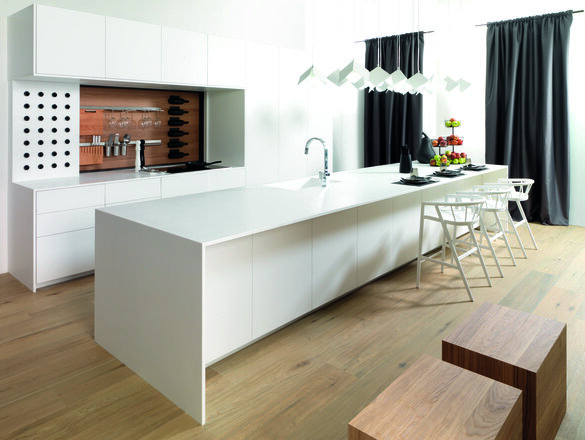
Krion® LUX L108 snowy cloudy
To achieve a modern open-plan kitchen, it is essential to choose materials that offer high durability, but also blend in perfectly with the style of the rest of the house.
In that sense, Krion® can be the perfect choice for a clean, minimalist and elegant finish. Its versatility makes it possible to create work surfaces and kitchen elements without visible joints, which facilitates maintenance and provides an impeccable finish.
In addition, the choice of neutral colours and soft textures can help to create a serene and harmonious atmosphere, in which the kitchen and living room become one unit, with no one part of the space dominating too much. White, grey and wood tones are ideal for this type of design, as they provide luminosity and soften the transition between areas.
→ Take a look for inspiration: Decorative guide, minimalist kitchens with Krion® Lux.
Krion® LUX L101 Carrara Soft
Keys to maximising space in small kitchens that open onto the living area
Kitchens open to the living room are a great way to create a feeling of spaciousness, but when it comes to small spaces, the challenge is even greater. However, with the right design and the use of smart materials, such as high-strength Krion® Lux surfaces, it is possible to maximise every nook and cranny without compromising on style.
One of the keys is to choose compact and functional furniture, such as a small island or a bar that does not take up too much space but is still practical.
Tall cabinets and overhead storage also help to make the most of vertical space, while open surfaces without too many decorative elements provide a greater sense of spaciousness.
Essential decorative elements in a kitchen that opens onto the living room
The decoration of a kitchen that is open to the living room should be thought of in a holistic way, so that the elements of both spaces complement each other.
Some of the key elements for a harmonious environment are highlighted below:
Windows
Windows are essential for kitchens open to the living room, as they allow natural light to flow into the space, creating a warm and welcoming atmosphere. In addition, large windows contribute to the feeling of continuity between the different rooms.
Colours
The choice of colours is crucial in an open-plan kitchen. Light tones, such as white, grey or beige, create a more spacious and luminous ambience, while accents in more intense colours, such as blue or green, can add character without overloading the space.
→ You may be interested in: Kitchen worktop colours to inspire you.

View the project on Carlet Housing, (Carlet, Spain)
Architecture: David Olmos
Interior design: Interior design ideas
Solutions from Porcelanosa Grupo, Gamadecor, l'Antic Colonial, Xtone, Butech, Noken and Krion.
Distribution
The layout of the elements in an open kitchen should optimise the work flow, allowing unobstructed circulation. A smart design that integrates appliances and preparation areas well will be essential to achieve a practical kitchen.
Furniture
Furniture should be simple and elegant. Opting for multifunctional pieces, such as tables with storage or open shelving, is an excellent way to save space while maintaining aesthetic coherence between the kitchen and the living room.