Kitchen trends 2026: keys to designing modern spaces
15/10/2026
The 2026 kitchen trends reflect a new way of understanding one of the most important spaces in the home. The contemporary kitchen is no longer conceived solely in terms of functionality: it is integrated into the interior architecture, takes center stage in daily life, and forms an increasingly close relationship with living areas.
This evolution is transforming both the layout of spaces and the choice of materials. Visually light compositions, seamless surfaces, organic shapes, and color palettes inspired by nature are gaining ground over overly compartmentalized designs.
But there’s more to it than that. The kitchen of 2026 is defined not only by its appearance, but by its ability to combine design, functionality, and durability. Solutions that make cleaning easier, make better use of storage space, and allow each element to be adapted to the user’s needs are becoming increasingly important.
Trends in modern kitchen design
Kitchen design is evolving toward more integrated, personalized, and versatile spaces. Far from conforming to a single aesthetic trend, current trends share a common goal: to simplify the space without sacrificing its functional and expressive possibilities.
Integrated and invisible kitchens
One of the main trends of 2026 is the pursuit of ever-greater visual integration between the kitchen and the rest of the home. This approach goes beyond simply hiding appliances. It involves designing the space as an architectural composition, where furniture, finishes, countertops, and lighting all speak the same design language.
Paneled refrigerators, storage columns, and retractable doors allow the more functional elements to be concealed when not in use. As a result, the kitchen can take on the appearance of a continuous cabinet front—a particularly appealing feature in homes where it shares space with the living room.
The key lies in reducing visual clutter: limiting the presence of freestanding elements, coordinating finishes, and carefully resolving the transitions between surfaces. In this context, materials capable of creating continuous planes become particularly important, as they help countertops, side panels, and wall coverings be perceived as parts of a single composition.
Handle-less kitchens
Kitchens without visible handles continue to gain traction in contemporary designs. Their appeal lies in their clean lines: the cabinet doors appear as uniform surfaces, with no elements to disrupt their geometry. Among the most common solutions are groove systems, machined handles on the fronts, and push-to-open mechanisms.
However, not all offer the same user experience. Opening systems should be selected with consideration for frequency of use, ergonomics, and ease of maintenance, especially for large-capacity drawers.
Organic shapes and rounded edges
Straight lines continue to play a fundamental role in kitchen design, but in 2026 they coexist with softer geometries. Islands with rounded ends, peninsulas with curved contours, and softened edges allow for movement in spaces traditionally dominated by orthogonal volumes.
Beyond their aesthetic value, these shapes can improve traffic flow, especially when there are walkways around an island. They also create a more seamless visual transition between the kitchen and the living room.
However, incorporating curves requires careful consideration of material selection. Not all surfaces can accommodate the same radii, manufacturing processes, or joining solutions. Krion® LUX solid surface offers particularly interesting possibilities for this type of design& thanks to its thermoforming capability. Through a transformation process, the material can be adapted to specific curved geometries and retain its shape once cooled.
Kitchens open to the living room and dining room
Open-concept kitchens continue to play a leading role, but their design is evolving. Rather than simply removing walls, the goal is to create a cohesive relationship between the different areas of the home. Integrating a kitchen into the living room involves considering aspects such as traffic flow, ventilation, lighting, and the continuity of materials.
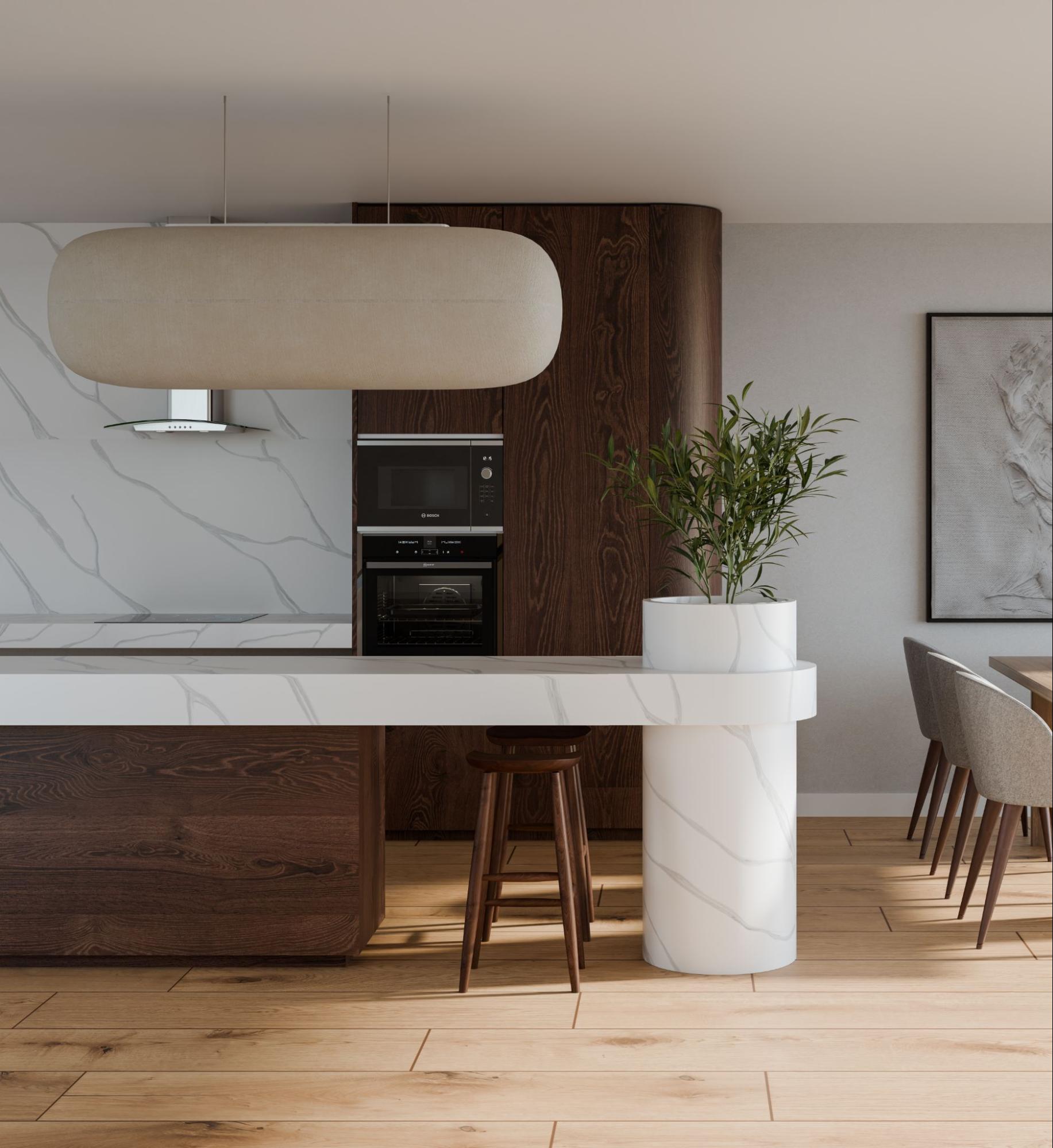
Krion® LUX Calacatta
One of the most effective strategies is to use a shared palette. The wood used in the kitchen cabinets can reappear on a bookshelf in the living room; the tones of the countertop can complement the wall coverings, and textures can serve as a unifying thread between spaces. In these designs, islands also serve an architectural function: they define spaces without the need for visual barriers.
Islands and peninsulas
Islands are no longer merely auxiliary surfaces; they have become elements that organize daily activities. They can bring together areas for food preparation, storage, cooking, and breakfast, while also serving as a meeting point between those who cook and those who use the space for other activities.
Hidden storage and integrated lighting
The clean aesthetic of modern kitchens depends, to a large extent, on good storage planning. Hidden pantries, full-extension drawers, organized tall cabinets, and dedicated compartments for small appliances help keep the countertop clear and make daily tasks easier. This trend stems from a fundamental idea: a visually organized kitchen requires functional solutions that make it easy to maintain that order.
Lighting also plays a decisive role. It is no longer limited to a single general light source but is organized into different layers:
-
Ambient lighting: provides uniform, comfortable light.
-
Task lighting: highlights the food preparation, cooking, and dishwashing areas, preventing shadows on the work surfaces.
-
Accent lighting: highlights textures, display cabinets, shelves, or specific architectural elements.
Trending colors for kitchens
The color palette for kitchens in 2026 moves away from exclusively cool color schemes and embraces spaces with greater visual depth. White isn’t going away, but it shares the spotlight with beiges, sand tones, greens, browns, and shades inspired by natural materials. The trend isn’t about incorporating as many colors as possible, but rather about creating balanced combinations where cabinetry, countertops, and wall finishes come together to form a cohesive look.
Warm and neutral whites
Off-whites, ivories, and soft beiges offer an alternative to all-white kitchens. They maintain the characteristic brightness of light tones, but introduce nuances that add warmth, especially when paired with natural woods and warm lighting. They’re an interesting choice for small kitchens, open-concept spaces, or projects seeking a timeless aesthetic.
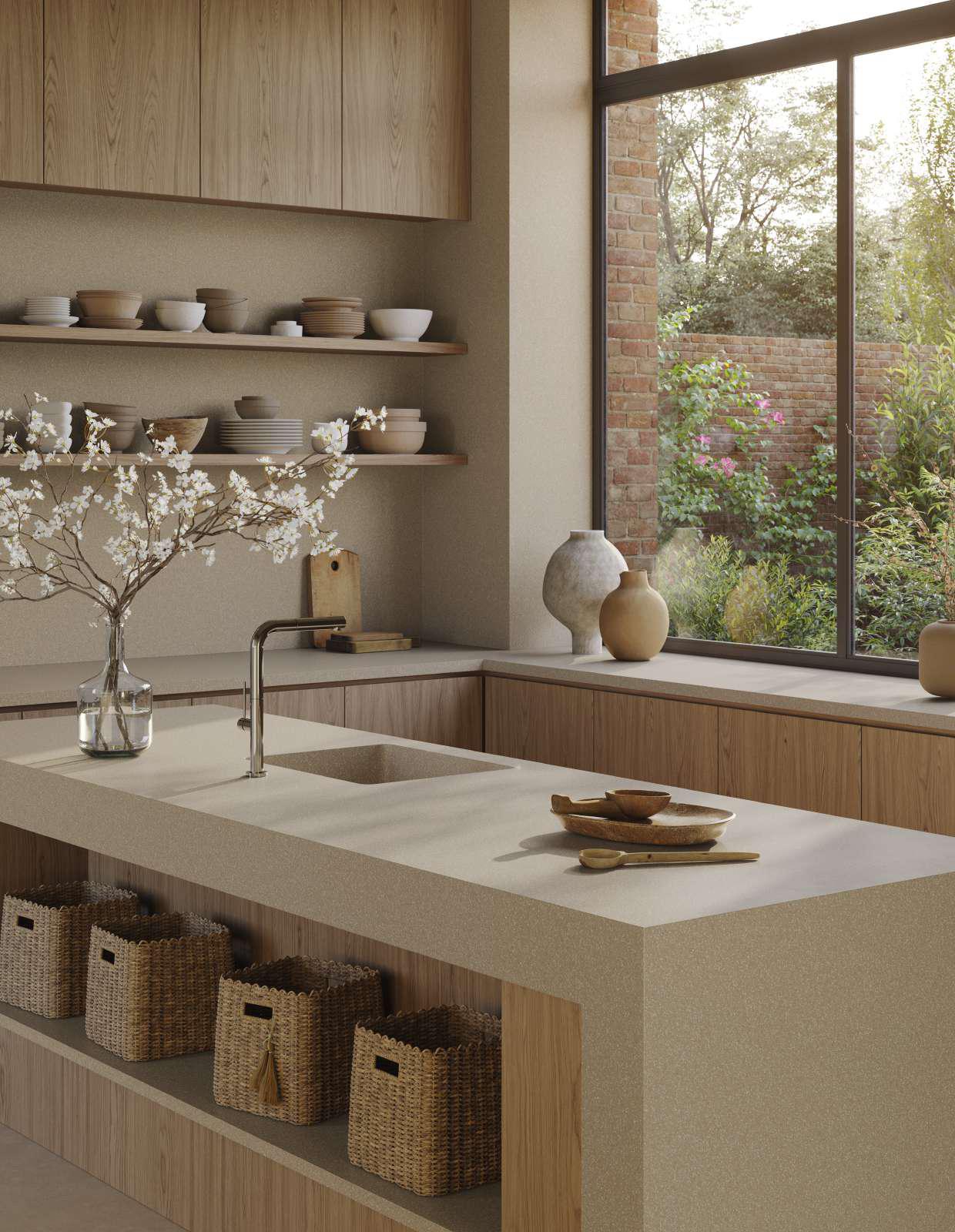
Krion® LUX MUD
Greens, terracottas, and earth tones
Sage, olive, and eucalyptus greens are establishing themselves as alternatives to traditional neutrals. Their visual connection to nature makes them a particularly good choice for pairing with wood, stone, and light-colored surfaces. Earth tones, ranging from terracotta to soft browns, create a greater sense of warmth and can be used on furniture, walls, and decorative elements.
Deep blues, matte black, and metallic accents
Petroleum blues, graphite shades, and soft blacks allow for the design of kitchens with a distinct visual identity. They are particularly striking when used on specific elements, such as a central island or cabinet fronts, and paired with a neutral-toned countertop. The contrast between dark surfaces and light materials helps define spatial volumes and prevents the overall look from becoming too uniform.
Color combinations between cabinets and countertops
One of the most important aspects of designing a kitchen is understanding that the color of the countertop should not be chosen in isolation. A light-colored countertop can balance dark wood cabinets or cabinet fronts in bold colors. Conversely, a countertop with a grain pattern or a more distinctive hue can add character to a set of neutral cabinets.
Trending countertops: materials, finishes, and styles
The countertop is one of the elements that most influences both the aesthetics and functionality of a kitchen. Your choice determines the relationship between the different elements, the user experience, and a large part of the cleaning and maintenance requirements.
Seamless, continuous countertops
Visual continuity is one of the most commonly used design elements in contemporary kitchens. It involves minimizing breaks between surfaces to achieve cleaner, more cohesive designs, where the countertop can extend to the sides, integrate with the wall, or adapt to different layouts.
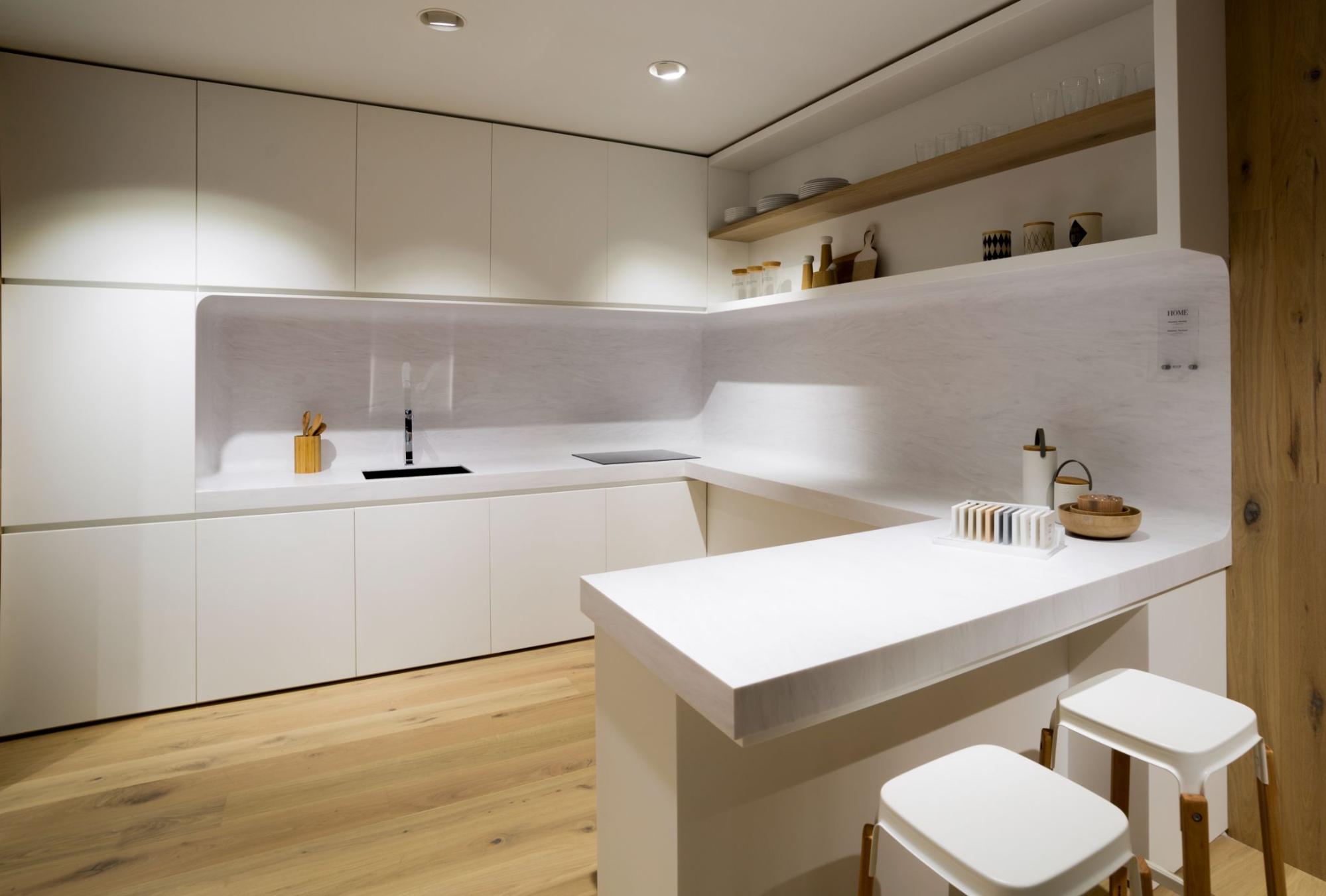
Krion® LUX Carrara Soft
This feature also has functional implications: seams and joints are areas that require special attention during cleaning. Solid-surface materials, such as Krion® LUX, allow for seamless joints. This makes it possible to create surfaces that appear visually continuous, even when they are fabricated from multiple slabs.
Its non-porous structure also facilitates routine cleaning by preventing liquids from being absorbed by the material’s surface. At the same time, a particularly interesting application is the seamless transition between the countertop and vertical cladding. This solution makes it possible to do without the traditional upstand in certain configurations and achieve a seamless transition through a more integrated design.
Integrated sinks
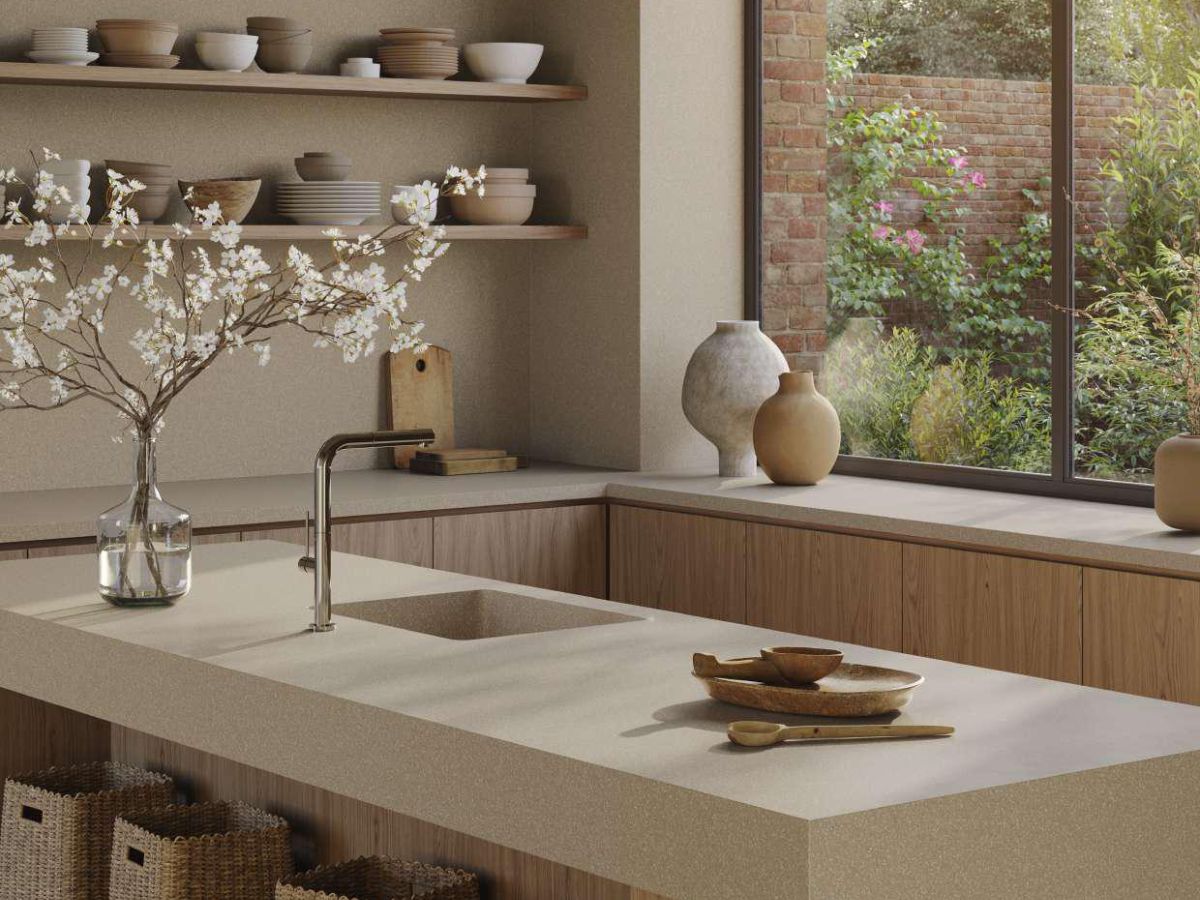
The sink is one of the areas where the most activities take place: washing food, handling utensils, and cleaning items used during food preparation. Traditionally, the junction between the sink and the countertop involves a change in material or a seam that requires special attention during cleaning. Integrated sinks made with Krion® LUX offer a different solution: combining both elements to achieve a more uniform visual transition.
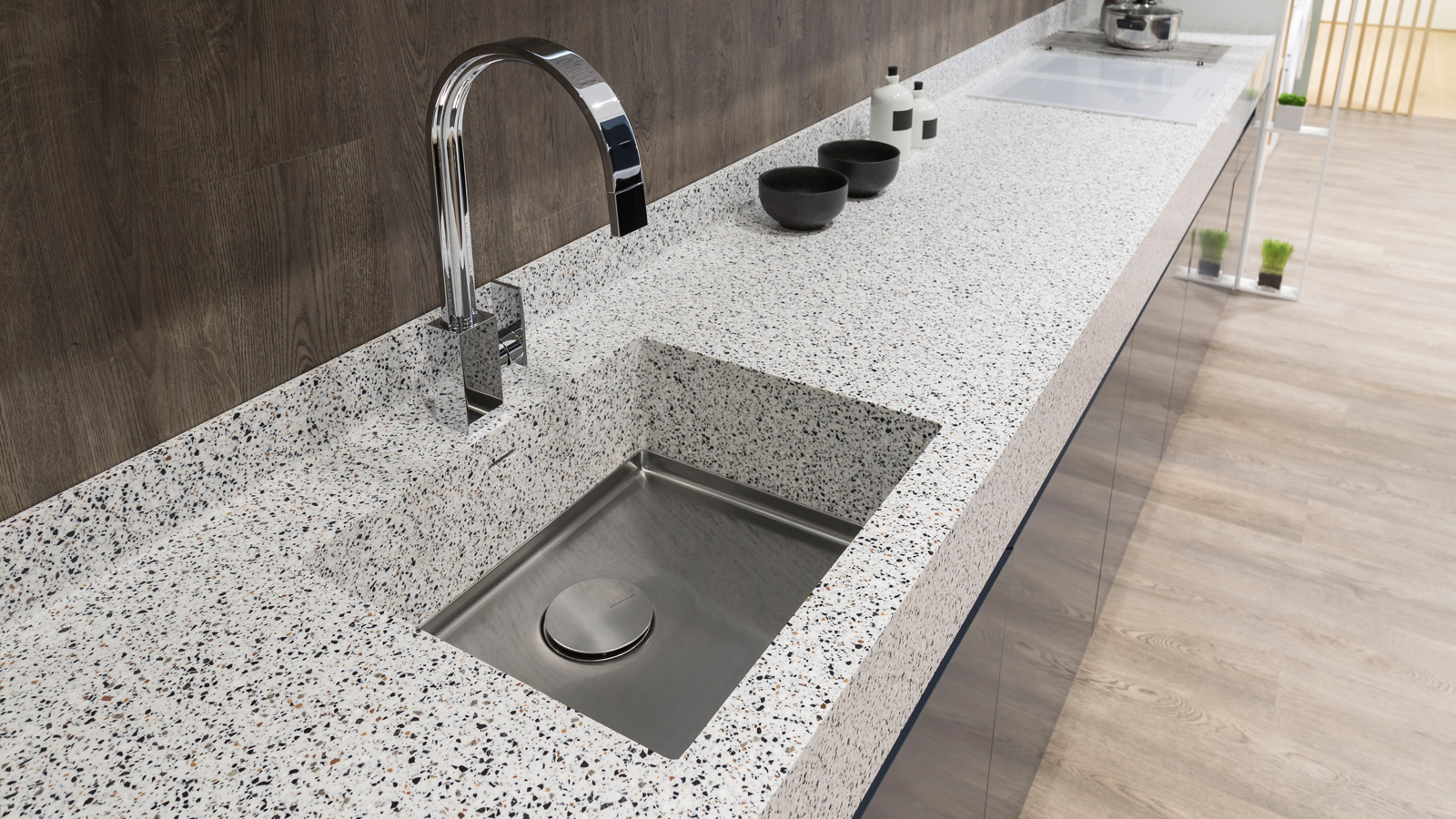
Krion® LUX Antico Bianco terrazzo
Materials and textures: wood, grooved surfaces, and easy-to-maintain finishes
Kitchen trends for 2026 focus on combining materials and textures that add warmth without sacrificing functionality. Natural-grained wood, grooved cabinet fronts, and stone-inspired finishes bring depth and personality to spaces, especially when paired with smooth, seamless surfaces.
Beyond aesthetics, ease of maintenance and durability are essential criteria. In this regard, Krion® LUX allows for the creation of countertops with no visible seams, featuring a non-porous surface that is easy to clean and repair, which contrasts with the texture of wood and decorative cladding. The combination of these materials makes it possible to design balanced kitchens where visual richness coexists with the demands of daily use.
Trends for small kitchens
In small kitchens, every design decision counts. The trends for 2026 favor floor-to-ceiling cabinets, hidden storage solutions, and handle-less cabinet fronts, which allow for better use of space and maintain a clean, uncluttered aesthetic.
Light, warm colors help enhance brightness, while seamless countertops reduce visual interruptions and reinforce the feeling of spaciousness. In this regard, Krion® LUX allows for the creation of custom surfaces with imperceptible seams, adapting to corners and complex layouts without sacrificing the continuity of the design.
Peninsulas are also gaining prominence as an alternative to traditional islands, providing an additional work or breakfast surface without compromising traffic flow.
Frequently asked questions about 2026 kitchen trends
What is the current trend in kitchens?
The main trends include open and integrated kitchens, cabinetry without visible handles, islands with organic shapes, natural tones, textured finishes, and seamless countertops. Custom storage, integrated lighting, and low-maintenance materials are also gaining particular importance.
What is the most elegant kitchen color?
Warm whites, beiges, sandy tones, soft greens, and earth tones stand out. Deep blues and dark tones are also used to create contrasts, especially on islands and cabinetry. The choice depends on the natural light, the dimensions, and the materials present in the space.
Which kitchens never go out of style?
Kitchens that combine a functional layout, a balanced color palette, and materials suitable for everyday use tend to stand the test of time best. It’s best to prioritize elements that are difficult to replace, such as countertops and cabinetry, and reserve more fleeting trends for decorative details.
What kind of kitchen countertop will be in style in 2026?
In 2026, seamless countertops will stand out, featuring matte finishes and designs inspired by natural materials, such as marble and stone. Beyond aesthetics, people are looking for surfaces that are durable, easy to clean, and capable of blending seamlessly with the cabinetry.
In this vein, Krion® LUX allows you to create countertops with seamless joints, integrated sinks, and custom shapes, combining design freedom and functionality. Discover our range of slabs.