Hotel Design: Creating memorable experiences for guests

06/06/2025 [Updated on 12/08/2025]
In the competitive world of hospitality, hotel design plays a key role in creating unforgettable experiences for guests. Every detail, from architecture to room decoration, contributes to the atmosphere and quality of the service offered.
In this article, we are going to explore the latest trends in interior design and analyze the requirements to obtain the prestigious 5-star classification. We will also address the fascinating question of whether 6- or 7-star hotels actually exist. Get ready to discover how design can make a difference in the hotel industry!
What will you discover in this article?
- The most notable hotel trends in interior design: explore the main innovations in hotel design that are shaping the industry.
- Learn how solid surface offers durable, aesthetically appealing and environmentally friendly solutions that are ideal for hotel spaces.
- Analyse the essential requirements that a hotel must meet to obtain and maintain the coveted 5-star rating, guaranteeing a luxurious experience for guests.

Reception designed with Fitwall® WAVE® decorative panels
5 trends that are adapting the most modern hotels
Interior design in hotels is much more than selecting furniture and colors. It involves creating functional spaces that are aesthetically pleasing, reflecting the hotel's identity and meeting the guests' needs. These are the decorative trends that the most current hotels are experiencing:
- Yes (out LOUD) to sustainability: Hotel design is increasingly focused on sustainability, incorporating eco-friendly practices and environmentally friendly materials and technologies. More and more hotels are implementing renewable energy systems, such as solar panels and wind turbines, to reduce their carbon footprint. They are also using eco-friendly materials and sustainable construction practices in their designs
-
Multifunctional spaces to cover various needs: Hotels are taking a more flexible approach to designing their spaces, creating multifunctional areas suited to the various needs and activities of guests. Some hotels have already chosen to create day/night spaces, turning their breakfast area into an elegant bar at night, offering artisanal cocktails and live music to create a lively and social atmosphere.

-
Including local and cultural influences: The incorporation of local and cultural influences in hotel decoration is a growing trend in the industry, and it seeks to offer guests an authentic and enriching experience that reflects the identity and spirit of the place they have travelled to. This practice aims to immerse visitors in local culture, highlight the traditions and heritage of the region and create a unique and memorable environment. For example, some hotels showcase artwork by local artists, sculptures, paintings or traditional crafts in common spaces, and others include the region's traditional architectural elements and styles, adapting them to contemporary design
-
Innovation through smart technology: The integration of technology into hotel design is constantly evolving, from home automation systems that control lighting and air-conditioning to mobile devices that enable guests to access services and personalize their stay
-
Opting for wellness and health programs: Hotels are paying increasing attention to their guest's wellness, incorporating spaces to work out, areas to relax and health-related and wellness services, such as spas and healthy eating programs
What is the importance of interior design in hotels?
Design plays a key role in the hotel industry, as it can make the difference between a common and extraordinary experience for guests. Here are a few reasons highlighting the importance of design in hotels:
- It creates an impressive first impression: The design of the lobby or reception area is crucial, as it is the first thing guests see when they arrive at the hotel. A carefully planned and attractive design can leave a lasting and positive impression, creating a welcoming feel and a sense of comfort from the outset.
- It reflects the hotel's identity and concept: The hotel's interior design must be consistent with its identity and concept. Whether it is a luxury boutique hotel, a modern and minimalist accommodation or a themed establishment, the design must convey that essence through the selection of materials, colors, furniture and decorative elements.
- It improves the functionality and flow of spaces: A well-thought-out and functional design will also help increase the comfort and efficiency of spaces. The strategic layout of the common areas, rooms and service areas, together with a proper selection of furniture and the optimization of traffic flow, guarantee a seamless experience for hotel guests and staff.
- It provides suitable amenities and services: Interior design takes care of the selection and arrangement of services in rooms and common areas. From the quality of the mattress and bedding to the bathroom fixtures and workspaces, a well-executed design ensures that guests enjoy a comfortable and functional environment, where all the necessary amenities are provided for their stay.
- It stimulates the sensory experience: Interior design can trigger the senses and create a memorable sensory experience. The use of adequate lighting, pleasant aromas, environmental music and tactile textures, among other elements, can awaken emotions and create a unique sensory experience that echoes in the guests' memories.
Requirements for a 5-star hotel: Exceeding the standards of luxury
5-star hotels are noted for offering high-quality services and amenities that deliver an exceptional experience to their guests. These establishments must meet a number of requirements in order to obtain and maintain their 5-star classification:
- Infrastructure and services
- Customer service
- Comfort and amenities in rooms
- Quality gastronomy
- Additional services
Meeting these requirements is a challenge, but the reward is a reputation of luxury and exclusivity.
Who grants 5 stars to hotels?
Stars in hotel classification are awarded by recognized national or international hotel entities and associations. These organizations have the authority and responsibility to evaluate and classify hotels according to a series of predefined criteria.
In many countries, there is a national or regional entity responsible for establishing and regulating quality standards for hotels and granting stars. For example, in Spain the ICTE (Institute for Spanish Tourism Quality) is the body responsible for certifying and classifying hotels according to their quality and services.

Hotel counter designed with Fitwall® Arco White Sand
Internationally, one of the most recognized associations is the FIJET (World Federation of Travel Journalists and Writers), which promotes quality in the tourism industry and grants stars to hotels in several countries.
Beyond the Stars: Are There 6- or 7-Star Hotels? Discovering Luxury Without Limits
There is no official classification for 6- or 7-star hotels recognized at an international level. Traditionally, hotel classification is based on a scale of 1 to 5 stars. However, in some cases, the terms "6-star hotel" or "7-star hotel" are used in an unofficial way to refer to exceptionally exclusive and luxurious hotels.

7-star Burj Al Arab Jumeirah Hotel Dubai
These ultra-luxury hotels usually offer a unique and extraordinary experience, exceeding the habitual quality standards and services of 5-star hotels. They are known for their attention to detail, personalized service, exclusive amenities and avant-garde design.
Sustainable materials for hotel design: Krion® Lux solid surface
In the hotel sector, sustainability is becoming increasingly important, and choosing materials that are both environmentally responsible and functional is crucial to providing a quality experience. Krion® Lux is a solid surface ideal for interior design projects that seek to combine aesthetics, durability and sustainability.
Made from alumina trihydrate and high-quality resins, Krion® Lux stands out for its exceptional strength and durability. Its almost non-porous composition makes it a hygienic material that is easy to clean and maintain, making it perfect for high-traffic spaces such as hotels.
In addition, its ability to be repaired allows it to retain its original appearance for much longer, reducing material waste and extending its useful life. Krion® Lux is also thermoformable, allowing complex shapes to be created to suit any design, and its bacteriostatic property prevents the proliferation of microorganisms.
On the other hand, RCKrion® K·Life 1100 is the quintessential white Krion® Lux. This material, in addition to offering the same purity and durability as Krion® Lux, now includes a minimum of 5% recycled content, making it even more environmentally friendly.
Finally, Krion® Line offers a robust, solid and homogeneous alternative, perfect for linear surfaces. Thanks to its high mineral content and natural inorganic pigments, it allows for virtually imperceptible joints, creating a continuous and highly resistant surface. It is also highly resistant to impact and abrasion, withstanding blows without altering its integrity. With exceptional fire performance, Krion® Line is classified as B-s1, d0 and has a minimum recycled content of between 6% and 20%, depending on the model, making it an ideal choice for hotel projects that require resistant, safe and responsible materials.
Hotel interior design
Hotel interior design plays a crucial role in creating an atmosphere that is both attractive and functional. From the lobby to the rooms, each space must be designed to offer comfort, style and a memorable experience for guests. The materials selected, the layout of the spaces and the decorative details are key to achieving the perfect atmosphere that captivates visitors from the moment they enter the hotel.
Hotel reception design
The reception is the first impression guests will have of the hotel, so its design must convey a sense of welcome, luxury and comfort. The use of materials such as Krion® Lux in the reception bar, together with a modern and minimalist design, creates an elegant and sophisticated atmosphere.
Continuous surfaces with no visible joints reinforce the feeling of cleanliness and modernity, while the durability of the material ensures that the space maintains its impeccable appearance over time.
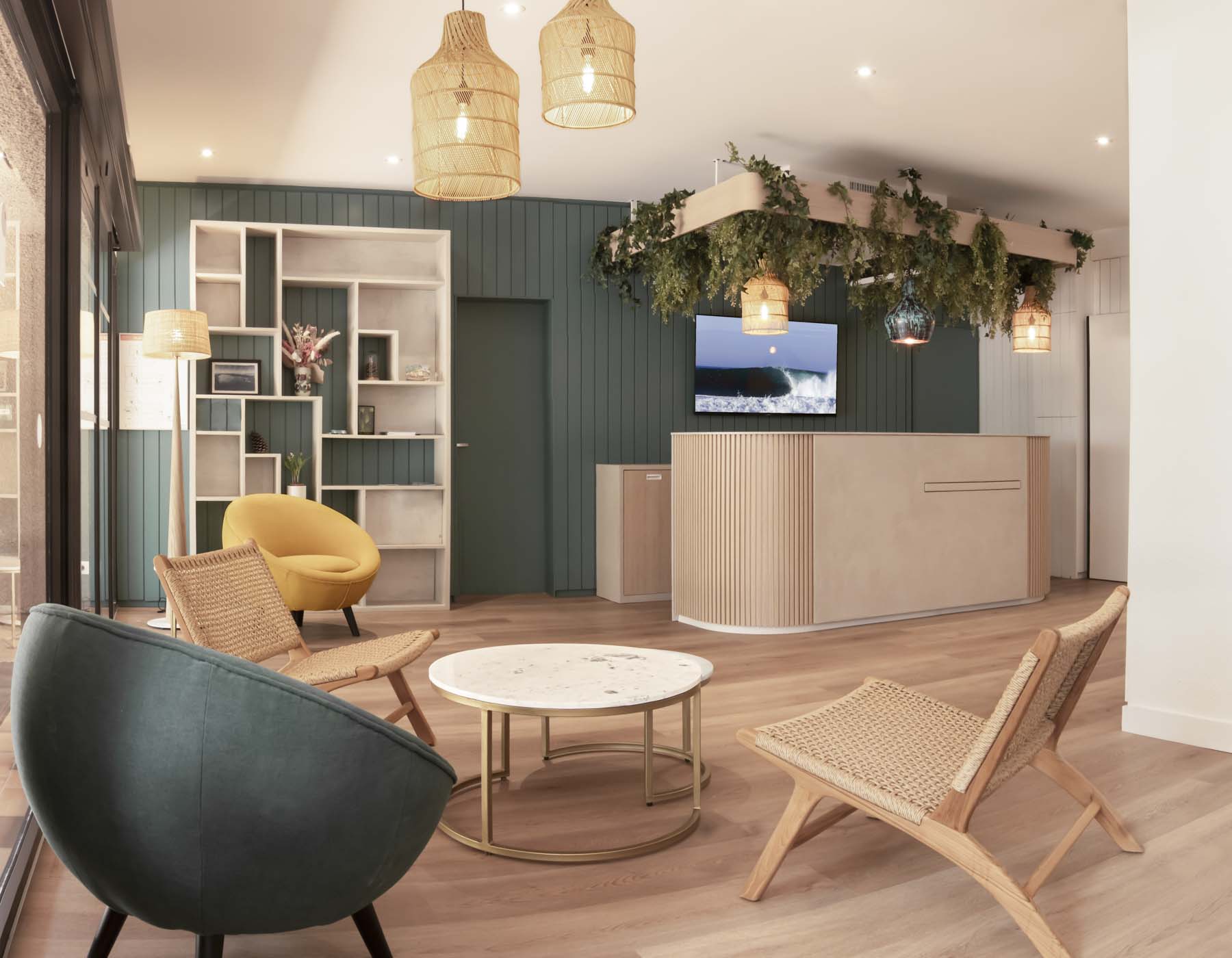
Hotel Les Acanthes
Hossegor, France
The furniture and layout of the space are also essential. Creating a natural flow that facilitates access and reduces waiting times is vital to improving the customer experience. In addition, lighting plays a key role in creating a warm and welcoming atmosphere.
Hotel room design
Krion® Lux is ideal for bathroom surfaces and countertops, providing elegance, durability and ease of maintenance, as well as bacteriostatic properties that guarantee hygiene. The continuous surfaces of this material, with no visible joints, create a fluid and harmonious design, allowing these elements to be perfectly integrated into the space. Thanks to its thermoformable properties, Krion® Lux allows for customised designs.
Hotel Decoration Designs with Krion Porcelanosa Group
Krion Porcelanosa Group has earned a prominent place in the world of hotel design thanks to its high-quality and elegant products. Below, we will present three hotels that have used Krion products to create impressive spaces:
Hotel Four Seasons, Casablanca

Hotel Four Seasons, Casablanca
Casablanca, Morocco
Architecture: Foster+Partners
With its avant-garde and contemporary design, this hotel stands out for its unique architectural details. By using Krion® sheets in the restaurant area as a decorative countertop, it has created a sense of continuity and a sophisticated style.
Hotel Castillo de Peñíscola

Hotel Castillo Peñíscola
Peñíscola, Spain
See more Porcelanosa Projects
Located in a coastal environment, this hotel has chosen a design inspired by materials with natural aesthetics and neutral colors. The shower trays, screens and bathroom mirrors are by Krion. The room's bathroom countertops have been designed using KRION® K·Life 1100 surfaces, which provide durability and elegance in a high traffic environment.
IBIZA CORSO HOTEL & SPA

Hotel Corso Hotel & Spa
Ibiza, Spain
See more Porcelanosa Projects
Facing the Mediterranean Sea, this hotel has become one of the most exclusive on the island thanks to its careful design and personalized services. Its ventilated façade follows a design of overlapping asymmetrical lines that connect the hotel's life with the natural and urban landscape of Ibiza.
In addition, the use of Krion® sheets as external cladding and the almost zero porosity of its mineral composition improve the building's acoustics and energy efficiency.