Learn about Krion® LUX and the thermoforming properties of solid surface

03/07/2025 [Updated on 16/06/2026]
Krion® Lux is a solid surface material designed for projects that require technical performance, visual continuity and design flexibility. Made with high-quality minerals, it offers a resistant finish and an appearance that can be adapted to a wide variety of applications. In this article, we focus on one of its most valuable transformation properties: thermoforming.
This article covers:
- How thermoforming makes it possible to create curved surfaces and bespoke pieces for tailored projects.
- The main steps professional fabricators follow to shape the material according to the technical and design requirements of each space.
What is thermoforming?
Thermoforming is a process that uses heat and pressure to shape solid materials. In the case of solid surface sheets, this technique makes it possible to create curved, rounded or more complex forms, opening up new possibilities for customised design.
Thanks to this property, Krion® Lux can be used in projects where straight lines are not enough and where surfaces need to respond to specific aesthetic, functional or spatial requirements.
Thermoforming solid surface materials
The thermoforming process involves heating the material sheet to a controlled temperature and then shaping it with the help of a mould and a vacuum membrane press.
This method allows specific curvature radii to be achieved while preserving the appearance of the Krion® Lux sheet. The finished piece maintains the visual quality and technical properties of the material.
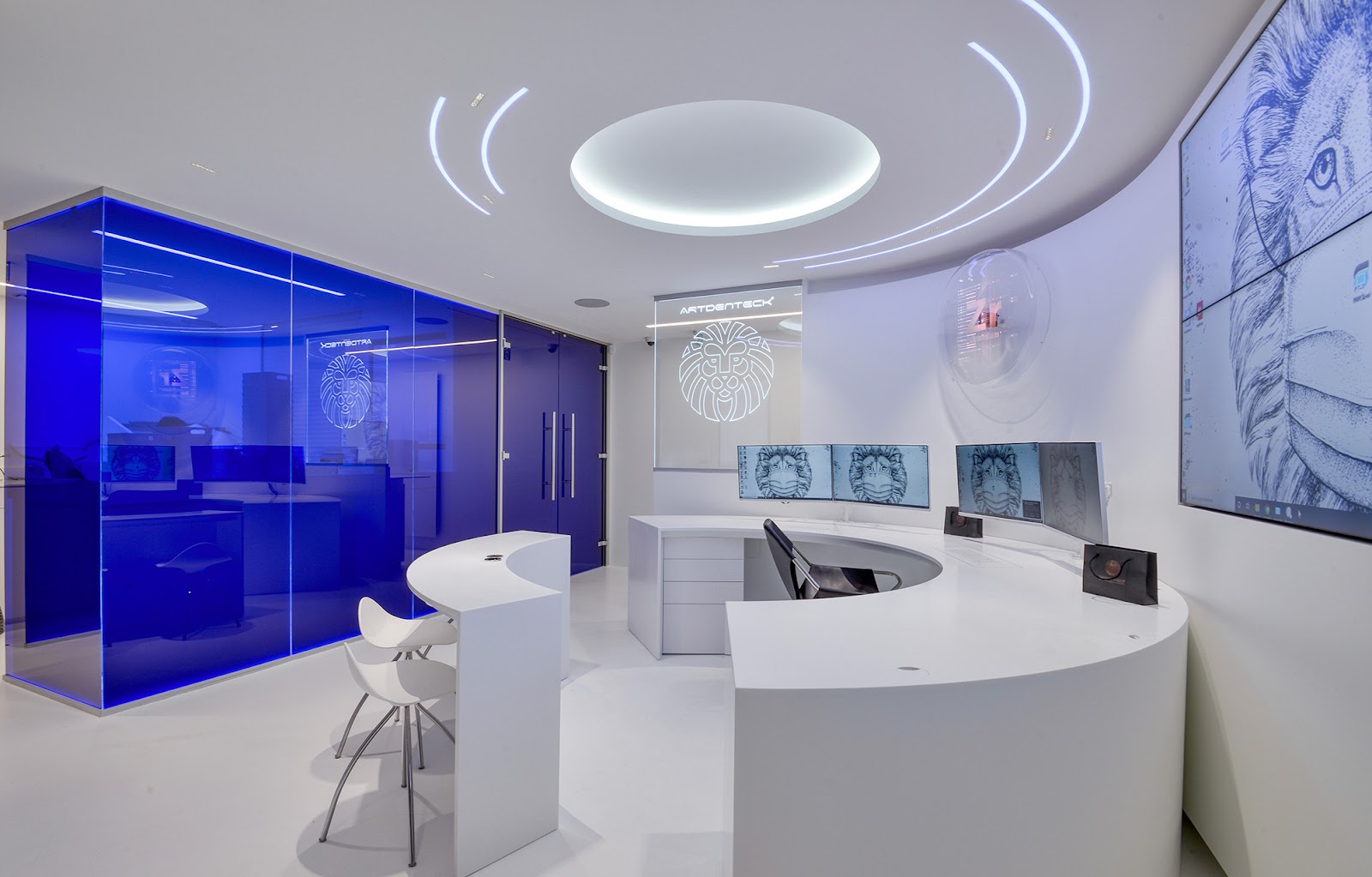
Project: Artendeck
Benefits of thermoforming solid surface
Thermoforming provides several advantages for design, architecture and interior projects. It expands the creative possibilities of the material while maintaining the performance expected from a high-quality solid surface.
Greater freedom for complex designs
This technique makes it possible to create curved forms and more elaborate structures that would be difficult to achieve with other materials. It gives designers and fabricators greater flexibility when developing bespoke solutions adapted to the technical, aesthetic and functional needs of each project.
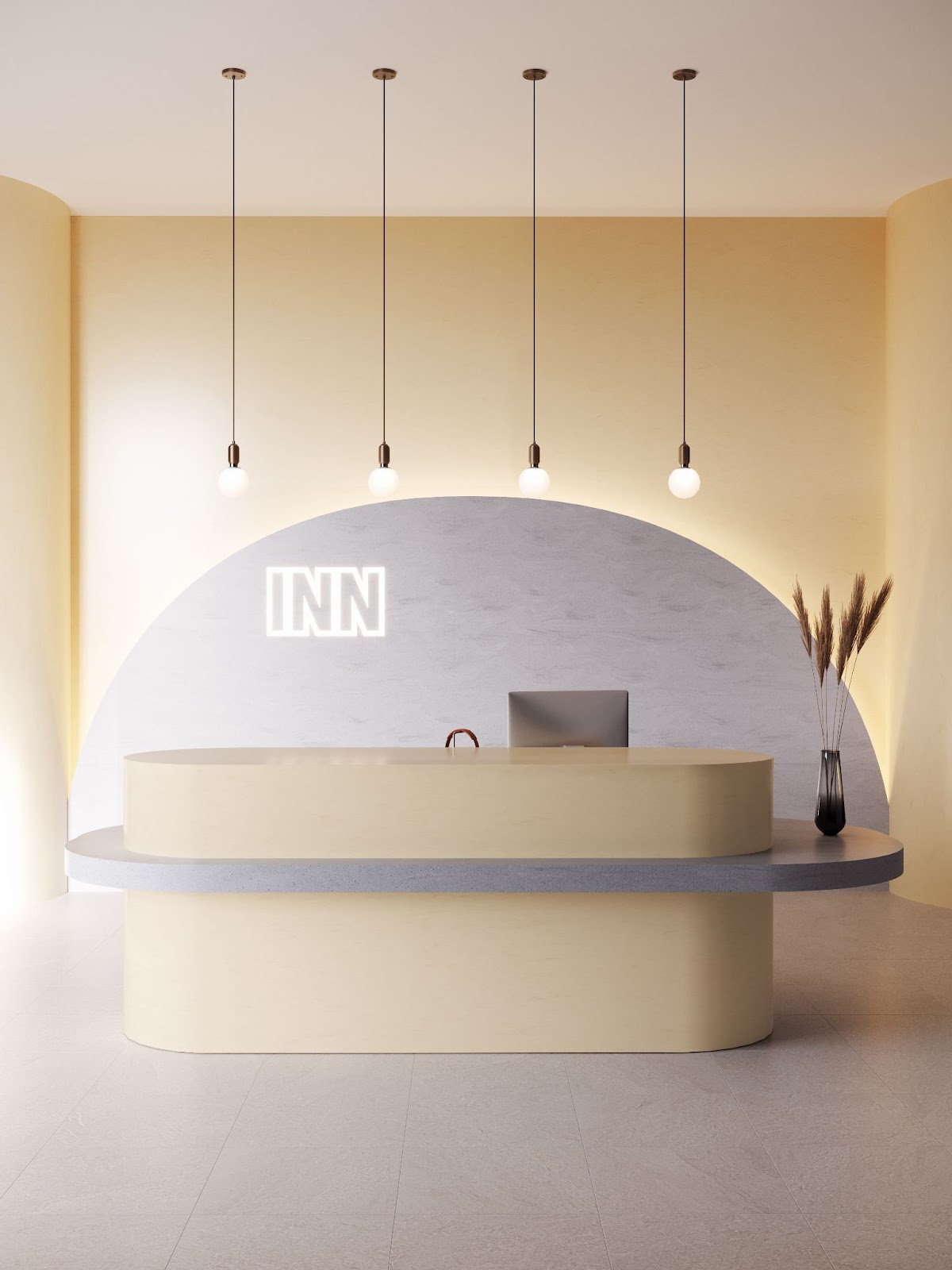
Krion® Lux Nebula Vanilla and Grigio
Preservation of the material’s appearance and properties
One of the main advantages of thermoforming is that the process does not alter the tone intensity or the properties of the material. Krion® Lux keeps its uniform appearance after being shaped, helping to achieve a clean and consistent finish.
Resistance and long-lasting performance
Thermoforming increases design flexibility without compromising the resistance and durability of the material. Once shaped, the surfaces continue to offer the same resistance to impact, scratches and stains as flat sheets, helping to ensure a long service life.
Thermoforming process step by step
The thermoforming process is essential for transforming Krion® Lux sheets into curved or complex pieces adapted to the needs of each project. The following steps outline how the process is generally carried out by professional fabricators.
Before starting, it is important to check whether the chosen Krion® Lux reference can be thermoformed to the radius required for the project. This information should be verified by the transformation specialist using the official Krion® Lux transformation manuals.
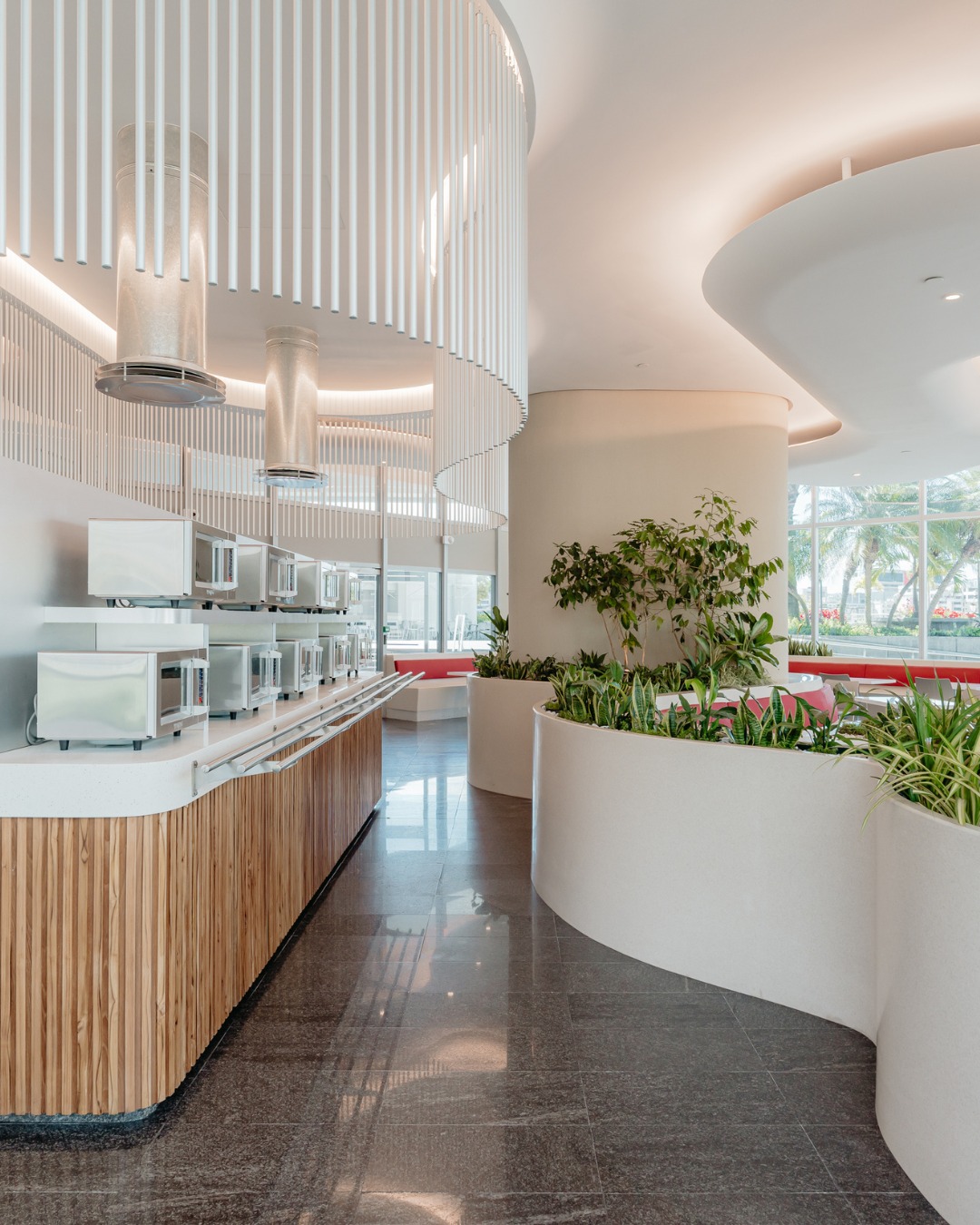
Digitel Tower Project
Step 1: preparing the material
Correct preparation is essential for achieving a successful final result. The edges and corners of the pieces are sanded to help prevent damage to the vacuum membrane during thermoforming and to reduce the risk of breakage in the piece being produced.
The surface must also be checked to make sure it is completely clean and free from impurities. Krion® sheets should be cut slightly larger than the final dimensions of the design, as the material may shrink during the heating process.
Step 2: heating the sheet
Heating is one of the most important stages of the process. The sheet must reach a precise and uniform temperature throughout its thickness so that it can be shaped correctly without affecting its properties.
The temperature and heating time are what make Krion® Lux malleable enough for thermoforming.
In general, the heating temperature is around 160ºC. However, lower temperatures between 130ºC and 150ºC may be used for simpler shapes with wider and more open radii.
The heating time depends on the type of oven used and the thickness of the Krion® Lux sheet. The most common systems are hot plate ovens, either single or double, and convection ovens with hot air circulation. As a general guide, the sheet can be heated for around 10 minutes, adding one extra minute for each millimetre of Krion® Lux thickness.
Careful control of both time and temperature is essential to obtain a reliable result.
Step 3: shaping in the membrane press
Once the correct temperature has been reached, the Krion® Lux piece is positioned on the mould inside the membrane press. The press applies even pressure across the material, allowing it to take the required shape.
The use of combined moulds helps the material adapt properly to more complex geometries without unwanted deformation. Vacuum pressing is especially useful in projects with detailed or intricate designs, as it helps the material fit the mould more accurately.
Step 4: cooling and stabilising the shape
After the piece has been shaped, it must cool in a controlled way so that the new form becomes stable. The material remains in the membrane press for approximately 40 minutes.
During this stage, the material must cool down to below 45°C. At that point, it recovers its normal rigidity and dimensional stability.
Step 5: final adjustments, if required
After cooling and inspection, some pieces may require final adjustments, such as sanding the edges or correcting small imperfections. This ensures that the finished element is ready for installation while preserving both its technical integrity and its appearance.
Thermoforming is one of the techniques that best demonstrates the versatility of Krion® Lux. It allows the material to move beyond flat surfaces and become part of more creative, curved and customised designs, while maintaining the properties that define this solid surface.
For technical questions or guidance on how to use Krion® Lux in a specific project, professionals can contact our K® Associate Quality Fabricators or access the exclusive services offered through A&D and Affinity. These programmes provide expert support throughout the project, from the design stage to final installation.
Frequently asked questions about thermoforming solid surface
Can solid surface be curved without heating it?
Yes, Krion® LUX can be cold-curved in gentle curvature applications, provided that the minimum radii appropriate to the sheet thickness are observed. As a guide, a 6 mm sheet allows for a cold-bending radius of 900 mm, whilst a 12 mm sheet allows for a radius of 1800 mm, based on a sheet length of 3600 mm.
To achieve tighter radii, more pronounced shapes or pieces with complex geometries, it is necessary to use thermoforming, as the heat allows the material to achieve the flexibility required to take on the desired shape.
At what temperature is solid surface thermoformed?
The usual temperature for thermoforming Krion® is between 130 °C and 160 °C, depending on the complexity of the piece and the radius to be achieved. Simple shapes with wide radii can be worked at temperatures close to 130 °C. In contrast, smaller and more pronounced radii require higher temperatures, around 160 °C.
The heating time depends on the thickness of the sheet and the type of oven used. As a guide, a 6 mm sheet requires approximately 16 minutes in an air or double-sided oven, and a 12 mm sheet, around 22 minutes. In single-sided ovens, these times increase to approximately 20 minutes for 6 mm and 30 minutes for 12 mm.
What is the minimum radius of curvature for Krion® Solid Surface?
The radius of curvature is not the same for all Krion® Solid Surface sheets. It depends on the colour code, the thickness of the material, the type of oven, the heating time and the geometry of the piece. Therefore, the minimum internal radius must always be verified before manufacturing the final piece.
In 12 mm Krion® Lux Luxury, the minimum internal radii vary depending on the colour code. Some examples are: 20 mm in L109 Bianco Cloud, 30 mm in L110 Nebula White and L907 Nebula Grey, 40 mm in L107 Grey Stripes, L507 Hickory and L508 Nebula Vanilla, 50 mm in L105 Carrara Dark, 60 mm in L905 Etna, 200 mm in L101 Carrara Soft, L102 Nacar, L103 Snow Fall and L505 Beige Marfil, and 240 mm in L903 Grey Cement.
In 6 mm Krion® Lux Luxury, some minimum internal radii are: 20 mm in L101 Carrara Soft, L102 Nacar and L505 Beige Marfil, 30 mm in L105 Carrara Dark, 40 mm in L103 Snow Fall and 100 mm in L903 Grey Cement.
What items can be manufactured using thermoformed solid surface?
This property allows for the creation of counters, worktops, washbasins, curved cladding, commercial furniture, display units, decorative pieces, signage and customised elements for retail projects, hotels, restaurants, healthcare facilities, offices or homes. The result is continuous, functional surfaces tailored to the technical and aesthetic requirements of each project.