Guide to replace your bathtub with a shower tray

13/01/2022 [Updated on 27/03/2026]
Replacing the bath with a shower traymade of solid surface is a very wise decision given all the benefits it offers, but you need to know how to do it properly to ensure the result is exactly what you had in mind.
If you are considering replacing your bathtub with a shower tray, you should know that it is always best to seek the help of a professional to carry out the work. Experience counts for a lot, and when it comes to something as important as your bathroom shower, having that expertise is essential.
That’s why we’ve put together a guide covering everything you need to know about removing a bath and installing a shower.
What will you learn in this article?
-
Advantages of replacing the bath with a shower tray
-
Why choose a solid surface shower tray?
-
Step by step: how to replace a bath with a shower tray
-
Which shower tray should you choose?
Advantages of replacing a bath with a shower tray
Showers are the future and, although a bath may be comfortable for soaking in a relaxing bath, a shower is a much more practical, economical and sustainable option. These are the main advantages:
- Time saving. It makes our daily lives easier, as a shower takes an average of 10 minutes compared to the 30 minutes of a relaxing bath.
- Saves money and energy, because we use less water when showering than when taking a bath.
- Aesthetically, the bathroom looks much more spacious if it has a shower, especially if the space is small.
- It is more accessible for people with mobility difficulties.
¿Why choose a solid surface shower tray?
The material Krion Shell® is an ideal choice for renovating spaces. Its strength, impact resistance and ease of maintenance make it the perfect choice perfect choice for a professional shower tray. Unlike other materials, it can be worked with standard workshop tools, making it easier to handle and reducing waste. Furthermore, its non-porous composition prevents the build-up of bacteria and fungi, improving hygiene and the durability of the space. This makes it an ideal solution for projects seeking a sustainable, durable and high-quality option.

Slope shower tray
Materials for replacing a bath with a shower tray
To renovate your bathroom, you’ll need more than just the shower tray, the wall tiles you’re going to install and the taps. There are a few other tools and materials you’ll need. Some of these are as follows:
- PVC pipework for the taps and for the shower drain.
- Connectors.
- Waterproofing product.
- Sledgehammer and pickaxe.
- Stripper.
- Electric or manual screwdrivers.
- Spanner.
- Spirit level.
- Silicone and gun.
- Pencil and tape measure.
- Gloves.
Step-by-step: How to replace a bath with a shower tray
Here is the step-by-step guide to replacing your bath with a shower tray:
Step 1: Take measurements
Before buying the shower tray and the rest of the materials, you need to take measurements to find out what size the shower tray should be and how many metres of pipe you’ll need. You should also measure the height to work out how many metres of cladding or panelling will be required.
Step 2: Turn off the stop valves
Before starting any plumbing work, make sure you turn off the water supply at the stop valves. This will prevent leaks and accidents during the work.
Step 3: remove the bath
Remove the bath, starting with the taps, the drain and the wall cladding. First, remove the drain valve. Remove the old cladding and the bath skirting. Next, remove the bath along with any grout or silicone sealant.
Step 4: preparing the drain for the shower tray
Adapt the drain for the shower tray, bearing in mind that the connection pipe for the shower tray valve must be at least 40 mm in diameter, or up to 50 mm if it is a high-flow valve.
Step 5: check the surface level
Using a spirit level, ensure that the surface is perfectly level. If it isn’t, you can level it using mortar.
Step 6: position the shower tray on the surface
Position the shower tray in place to check that the drain and the hole in the tray are aligned. Once checked, remove the tray.
Step 7: Waterproof the area
Waterproof the area, including both the shower tray and the walls, using your chosen material.
Step 8: apply the adhesive to the surface
For a professional finish, use Butech P-404 adhesive and spread it over the surface where you are going to install the shower tray.
Step 9: Position the shower tray and connect it
Place the shower tray in position, ensuring once again that it is correctly levelled, connect the valve and fill it to prevent gases from escaping from the drainage system.
Step 10: allow the sealant to dry for at least 24 hours
Leave the adhesive or sealant to dry for at least 24 hours to ensure the shower tray is firmly and securely fixed.
Step 11: Protect the shower tray to install the cladding
Waterproof the wall and then install the new panelling or cladding – this could be Porcelanosa – using the appropriate adhesive and leaving a 3 mm expansion joint. Then grout the joints.
Step 12: Seal the expansion joints
You can use Butech P-404 adhesive to seal the expansion joints, as this product will give the joint excellent elasticity, strength and adhesion.
Step 13: fit the decorative grate over the drain
Fit the decorative drain grate to provide an aesthetic finish that matches the rest of the installation.
¿Which shower tray should you choose?
When choosing a shower tray, the most important criteria are impact resistance, ease of cleaning and adaptability to the space’s requirements. In this regard, Flow, the shower tray made from Krion Shell® , stands out as one of the best options on the market.
FLOW
Flow is an ultra-slim shower tray made from Krion Shell®, a material developed by Krion based on minerals and resins containing recycled PET. Designed to adapt to all types of spaces, it is available in a wide variety of sizes and can be cut to size on site, making installation easier.
Its design, featuring soft lines and a seamless aesthetic, is complemented by a non-slip surface available in two textures — Class I and Class III — which ensure safety without compromising visual harmony.
Furthermore, the coating on the Flow shower tray makes cleaning and maintenance significantly easier, reducing the time and effort required to keep it in perfect condition. Its surface is impact-resistant and, should it suffer any damage, can be easily repaired, thereby extending its service life.
Thanks to its reduced thickness, the shower tray can be installed either as a surface-mounted or recessed unit, improving accessibility and making it particularly suitable for people with reduced mobility. Furthermore, its design allows any type of screen to be fitted directly onto the edge, without the need for additional modifications.
Finally, its innovative composition gives it sound-absorbing properties, dampening the sound of falling water and helping to create a quieter, more intimate and comfortable shower environment.
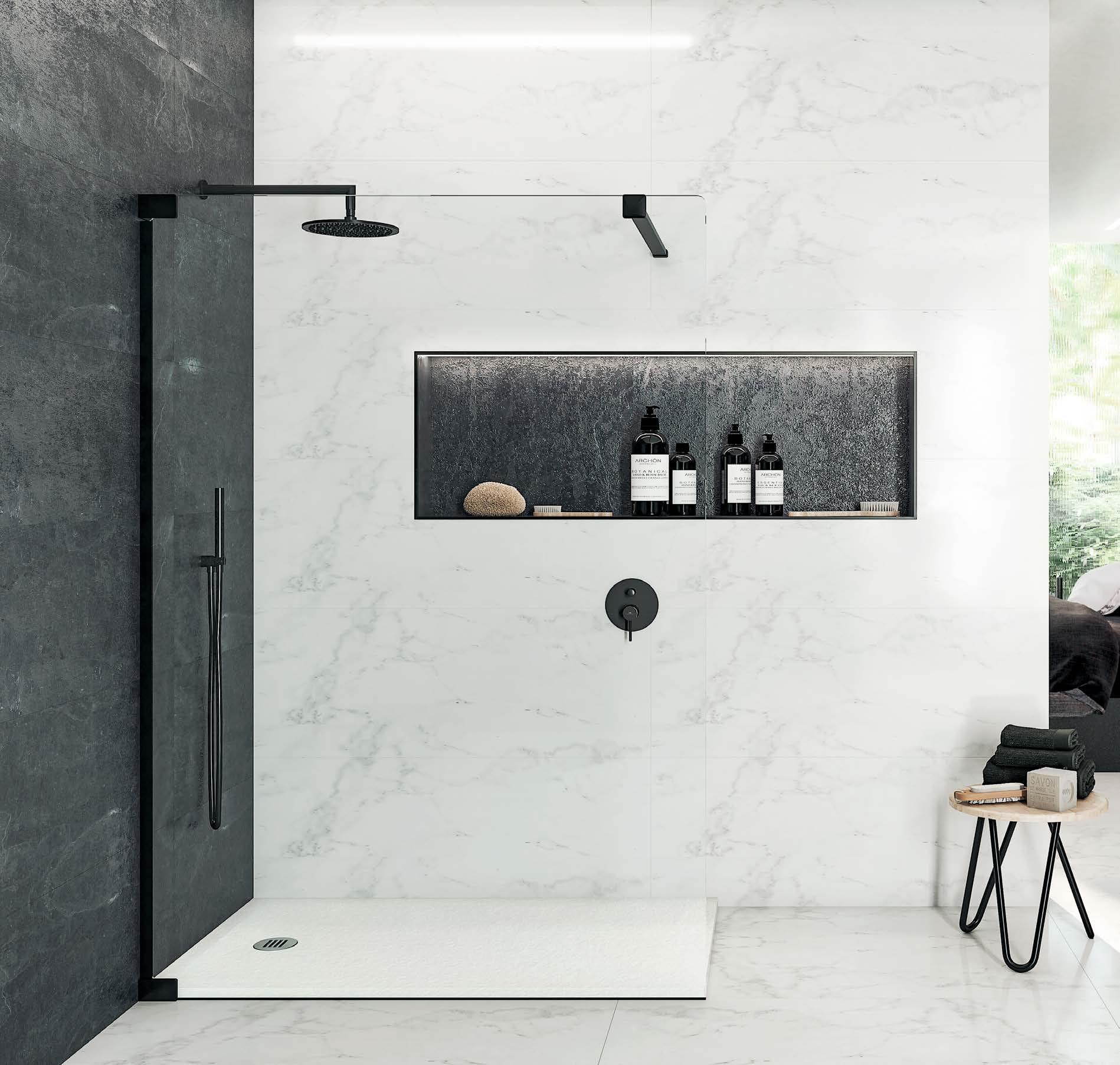
If you’re replacing your bath for a shower tray, these options, available in a range of sizes, are the ideal choice. Visit your nearest Porcelanosa showroom to see all the details in person.

,