How to cut Krion® Solid Surface: complete guide to perfect cutting
04/11/2025 [Updated on 13/11/2025]
Krion® is a highly versatile and resistant material, manufactured in sheets, which requires a transformation process for its application in the creation of furniture and large architectural projects. In fact, it can be cut, joined, thermoformed and backlit, allowing it to adapt to a wide variety of designs and shapes.
To achieve a high-quality finish and ensure that the final product is flawless, with no visible imperfections and exceptional durability, it is essential to use specific transformation techniques, such as cutting, which guarantee optimal results in every project.
What will you discover in this article?
- What is Krion® and why choose it
- Types of cuts: for cutting and pre-gluing
- Tools needed to cut Krion®
- Additional recommendations
What is Krion® LUX and why choose it?
Krion® LUX is a material composed mainly of natural minerals, mostly alumina trihydrate (ATH), and acrylic resins. This combination gives it a homogeneous, resistant and easy-to-work structure, making it ideal for a wide range of applications in both residential and commercial projects.
Unlike other materials such as quartz, Krion® LUX has a number of unique advantages that make it a preferred choice in design and architecture:
- Visual and functional continuity: it allows for joints without visible seams, creating monolithic surfaces ideal for wet areas or areas of intensive use.
- Hygiene: with bacteriostatic properties, it prevents the proliferation of microorganisms.
- Repairability: it has excellent resistance to small cracks, and surface damage or scratches can be easily restored by sanding, extending its useful life without replacing parts.
- Thermoforming: it can be moulded into curves, making it an excellent solution for wraparound designs or adaptations in custom designs and projects.
- Aesthetic stability: it is highly resistant to exposure to moisture or UV light.
- Aesthetic variety: it offers a wide range of colours and finish options, including options for backlighting.
- Zero moisture absorption: its compact and homogeneous structure prevents the penetration of liquids, making it easy to clean and maintain, even in high-traffic areas such as bathrooms, kitchens and public areas.

Types of cuts for Krion® solid surface
When working with Krion® LUX, one of the first considerations is how to cut the material to suit the needs of the project. Depending on the application and the type of piece to be obtained, there are two main types of cuts: cutting for cutting and cutting prior to bonding.
Cutting for assembly
Cutting for assembly divides a Krion® LUX sheet into smaller pieces suitable for use in the project. This cut adjusts the dimensions of the material for the subsequent stages of transformation, ensuring that the pieces are manageable and within the required specifications.
Pre-bonding cutting
Pre-bonding cutting ensures that Krion® LUX pieces are correctly aligned for joining. This cut must be precise to ensure that the joints between the pieces are invisible and free of irregularities, allowing for a stable and functional bond.
Tools for cutting Krion® LUX
Cutting Krion® LUX requires specialised tools that vary depending on the desired end result. Depending on whether it is for cutting or prior to bonding, there are different machines recommended for this purpose. If you are thinking of adapting your workshop, you should take these recommendations into account.
4.png)
Tools for cutting
Tools such as circular saws, jigsaws and vertical saws will be used to perform this type of cut.
Cutting with a circular saw
There are fixed circular saws and mobile circular saws. The difference between them is that mobile saws are usually used for areas where fixed saws cannot be accessed, for example, at the final installation site, but the cut and the type of disc used are the same. Below is some information about cutting with this type of machine:
- These are usually high-powered machines as they rotate at high speeds while cutting the material.
- Tungsten carbide (hard metal) discs with triple teeth are used. Diamond discs provide better performance when cutting with water, but are not recommended for dry cutting as they tend to clog.
- Discs with inclined teeth, at an angle of between -5o and 10o, similar to those used for cutting aluminium, are recommended.
- Cutting discs should have a module of approximately 3.125, approximately 8 teeth per 25 mm diameter.
- Cutting discs must be correctly sharpened; unsharpened discs can cause cracks or fissures under high stress. An annoying noise during cutting indicates that the disc is not sharp enough.
- It is advisable to always use the same disc to cut the material and not to use it for cutting other materials.
Cutting with a jigsaw
This tool is often used to make curved or complex cuts, but it causes many irregularities in the materials due to its aggressive cutting. It is considered a cutting tool for dismantling because it cannot be glued directly after cutting; it should be reworked with a milling machine. In addition, it does not make very fast cuts and produces a lot of vibrations, which will be felt in the user's arms. It should be noted that this machinery causes stresses that can lead to breakage.
Vertical saw cutting
This machine works in a similar way to a fixed circular saw. The only difference is that the disc must be moved in order to cut the material. Pre-cutting fixing ensures that the cut is straight without any misalignment, as could happen with a fixed mitre saw. It should also be noted that the introduction of the material into the housing is less ergonomic as different heights must be overcome.
Laser cutting and water cutting could be introduced as types of cutting for cutting pieces, but these are even less clean than those described above. Laser cutting can be used to engrave logos or labels that contrast with the natural colour of the sheet.
Tools for cutting prior to gluing
Tools such as a manual milling machine, CNC or Tupi will be used. Below, we explain the characteristics of each of them:
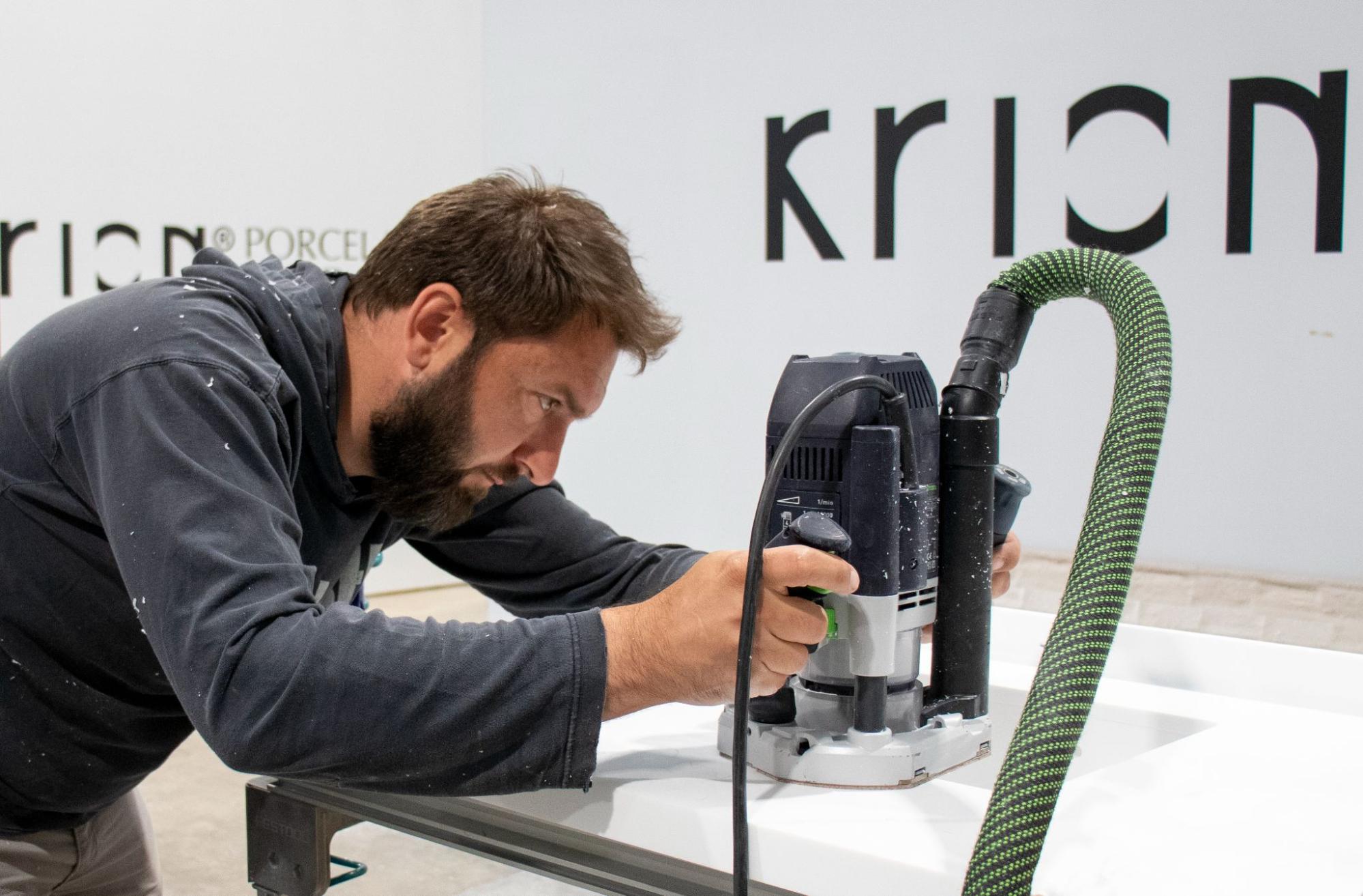
Manual milling machine
When selecting a manual milling machine, certain requirements must be taken into account:
- It must comply with the power and speeds of the milling cutters to be used. A speed that is too high or too low can affect the cut, which will be reflected in the result of the invisible joint.
- It must have a Z-axis descent system in tenths, as operations with materials such as half-round mouldings require a certain degree of precision.
- There are cutters with different neck diameters, usually 8 mm or 12 mm.
- The milling machine must incorporate a housing change system for them.
- For a clean cut, a guided support system will be necessary. It is important that the base of the milling machine is circular so that, if the support moves, the axis of rotation of the cutter remains in position.
- Vibration or oscillation of the milling cutter during cutting can affect the cut, so it is advisable to ensure that the Z height does not vary due to vibrations when cutting.
- Cleaning and maintenance of the milling machine is essential, as one of the main causes of machinery breakdowns is lack of maintenance.
- It is advisable to always have a supply of well-sharpened or slightly worn milling cutters available.
- When profiling, always use milling cutters with bearings.
- Use all possible tools to ensure that the cut is always clean and without irregularities.
- Be familiar with how the machine works and use it correctly.
CNC milling machine
A CNC (Computer Numerical Control) milling machine is a machining tool used to make precise cuts. It works in a similar way to a manual milling machine, but with the advantage of being automated by a software-controlled system. In this machine, a cutter, which is inserted into the spindle, rotates thanks to the machine's motor, and its speed and hardness allow it to cut into the material by removing chips.
There are different types of CNC milling machines, each with specific technical characteristics. However, one of the most important factors to consider is the number of axes that the machine can move. The greater the number of axes, the more possibilities there are for making more difficult cuts.
Tupi
A tupi machine is a power tool used to mill or profile edges or specific areas of hard material pieces. It consists of a fixed table and a rotating system. The latter causes the cutter to rotate and the operator drags the material so that the cutter makes the desired cut.
Additional recommendations
Once the appropriate machinery for each type of cut has been defined, it is essential to apply a series of good practices to ensure optimal results and avoid damage to the Krion® LUX sheet. These recommendations will result in clean, precise surfaces that are ready for subsequent joining or installation.
- Cutter selection and compatibility: in most cases, the same cutters can be used for the different machines used in the process. For profiling operations, the use of helical cutters is recommended.
- Maintaining the cutting edge: keeping the cutters in good condition is essential to avoid irregularities in the edges. A blunt tool generates excessive friction, which can cause microcracks or internal stresses.
- Adjustment of rotation speed and feed rate: each cutter must operate within the speed parameters established by the manufacturer. An inappropriate speed can alter the surface of the material or compromise dimensional accuracy. It is advisable to maintain a constant balance between the rotation speed and the cutting feed rate: feed rates that are too slow or too fast can cause irregularities or overheating.
- Feed control and joint quality: in the case of cuts prior to gluing, excessively slow feeds can alter the pigmentation of the sheet and create visual differences in the joints. Adjusting the cutting feed in a compensated manner ensures a uniform joint without variations in tone.
- Procedure with CNC milling machine: it is recommended to first perform an initial roughing and then a finishing profiling. This sequence improves the precision of the edges and reduces the possibility of tension or deformation in the material.
- Cuts in coloured sheets: for coloured sheets, it is preferable to mill a very shallow layer —approximately 0.5 mm— and increase the feed rate.
- Correcting imperfections: if deviations or irregularities are detected after cutting prior to gluing, the operation must be repeated. A second cut ensures the precise alignment and continuity necessary to obtain an imperceptible joint.
- Securing small pieces: when using a CNC milling machine on small pieces, it is advisable to secure them with masking tape or another auxiliary fastening system. This method prevents the parts from moving or being thrown off due to the high speed of the milling cutter.
To guarantee quality when working with Krion® LUX, the Affinity programme is the best option for transformers. It offers continuous training and personalised technical support, ensuring that workshops are fully trained in the proper handling of Krion®.